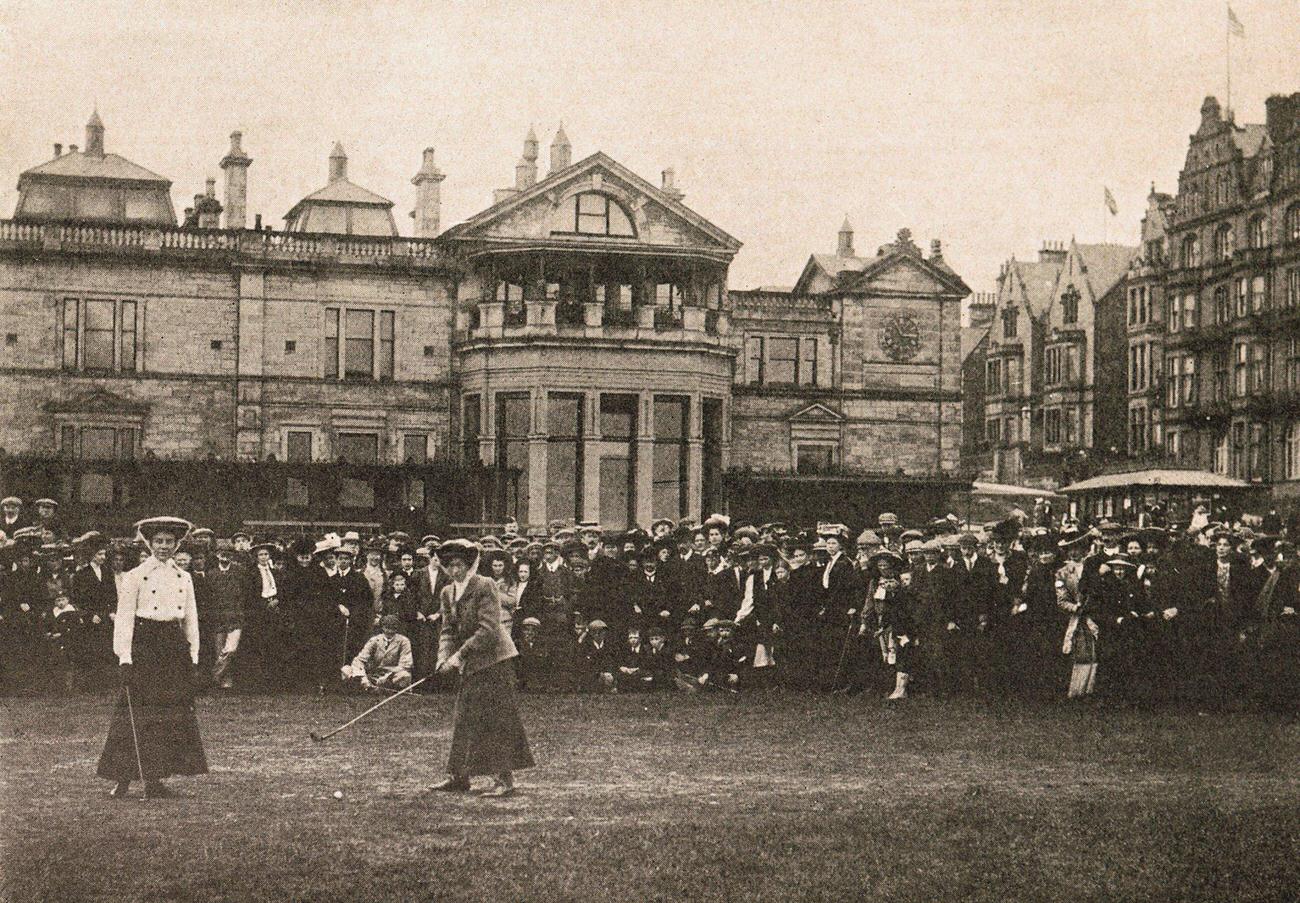
Crowds press in along the edge of the green at St Andrews, turning the Ladies Golf Championship Final into a public spectacle as much as a sporting contest. In the foreground, Maud Titterton addresses her ball while Dorothy Campbell stands poised nearby, their long skirts and tailored jackets reminding us how early women golfers competed within strict expectations of dress and decorum. Behind them, rows of spectators in hats and dark coats form a living grandstand against the clubhouse architecture, emphasizing just how much attention women’s golf could command in 1908.
A closer look reveals the drama of match play written in body language: the hitter bent into concentration, the opponent watching, and a hush implied by so many faces fixed on one small white ball. The scene is dense with period detail—caddies, onlookers, and the compact, watchful ring around the players—offering a vivid snapshot of championship golf before modern ropes, scoreboards, and television towers. It’s a moment where athletic skill and social theater share the same turf.
Placed within the wider story of women in sport, this photograph from the early 20th century helps explain why St Andrews holds such a powerful place in golf history. The Ladies Golf Championship Final between Titterton and Campbell stands as evidence of serious competition and growing audiences, even as the game’s traditions shaped how that competition appeared to the public. For readers searching historical golf photos, women’s golf history, or the roots of tournament play at St Andrews, this image provides an evocative doorway into an era when every stroke carried both sporting weight and cultural meaning.