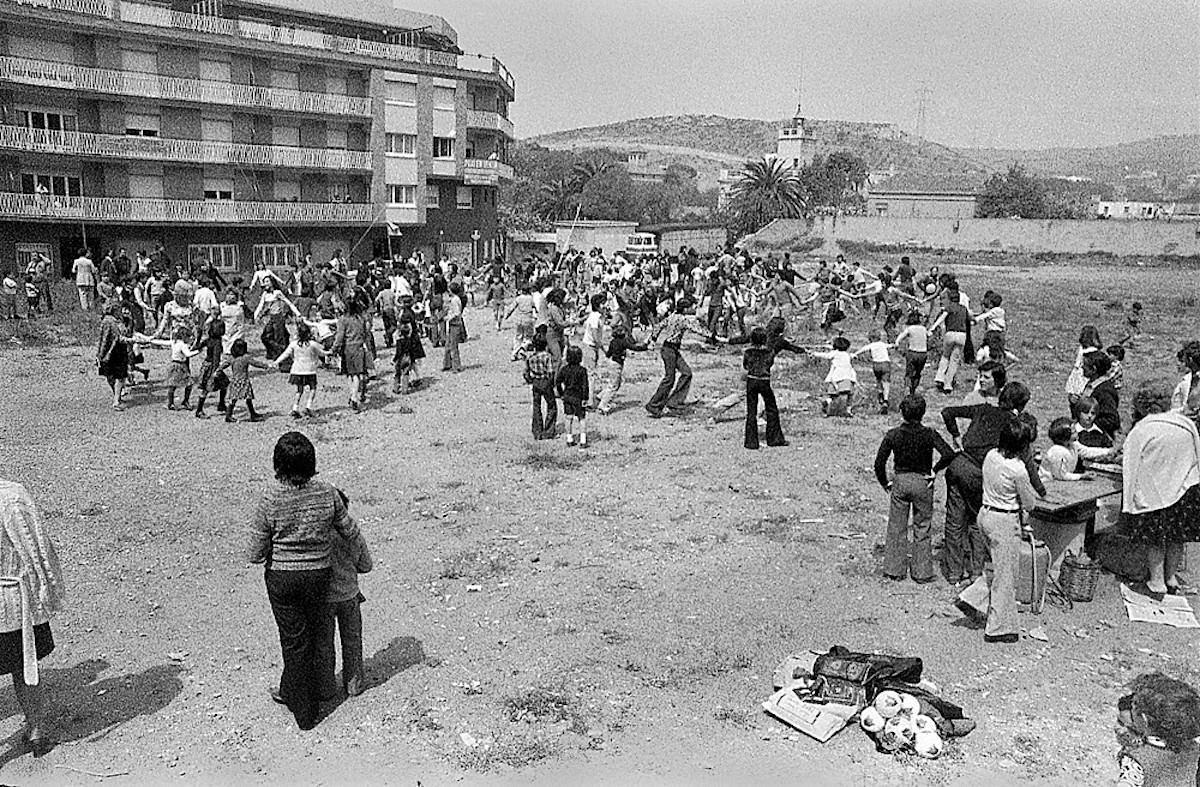
A wide, dusty open lot in Barri de Bufalà becomes an improvised playground, where children and teenagers spill into the space in loose circles and fast-moving clusters. Apartment blocks loom at the edge, their balconies lined like tiers above the commotion, while the far background opens toward low hills and scattered trees. The scene has the unmistakable energy of a neighborhood that turns whatever ground it has into a place to meet, shout, and play.
Sport here feels less like an organized match and more like a communal ritual of motion: running, linking arms, chasing, and cheering amid the churn of bodies. Small groups on the margins watch, talk, or hover near makeshift tables, and a few footballs rest on the ground as if waiting their turn. Details like flared trousers and casual streetwear root the photograph firmly in the 1970s, capturing Barcelona’s everyday life far from postcard views.
Set in 1976, the image offers a social history of the city from below—how public space in working neighborhoods was lived in, negotiated, and shared. It’s a snapshot of play as infrastructure, when the street and empty plots functioned as a gymnasium, a social club, and a stage for childhood all at once. For anyone searching vintage Barcelona photos, 1970s street sports, or the local memory of Barri de Bufalà, this photograph preserves the sounds and rhythms that buildings alone can’t record.