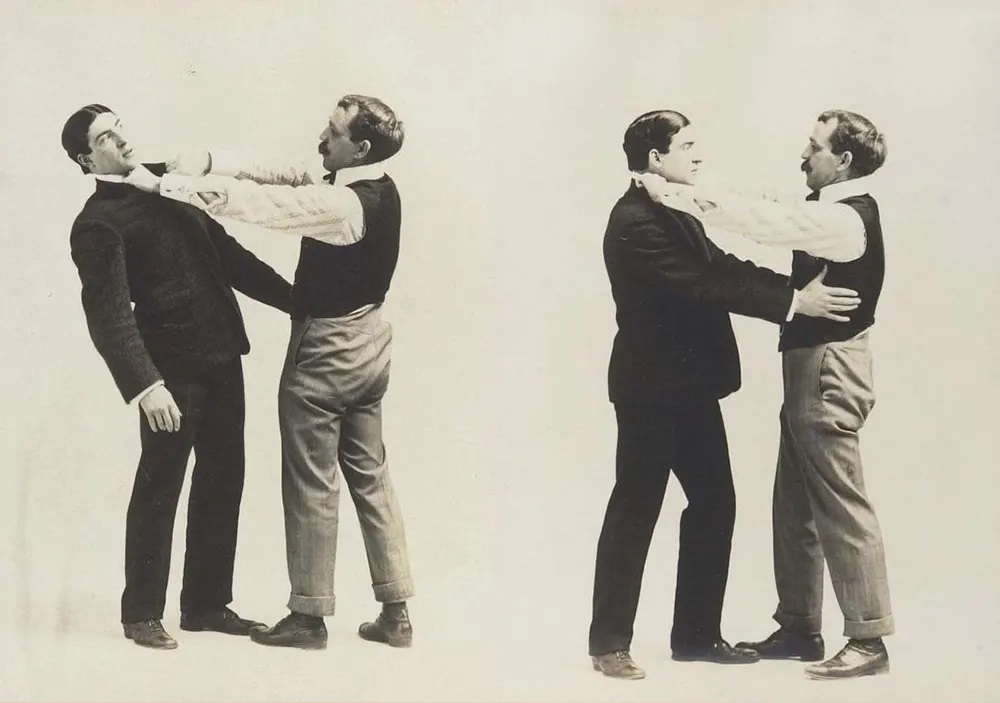
Staged like a lesson straight from a Victorian training manual, this 1895 self-defense guide uses crisp studio photography to freeze a sequence of close-quarters maneuvers. Two well-dressed men demonstrate a firm two-handed grip at the throat, their stiff collars, waistcoats, and tailored jackets underscoring how “sport” and personal safety were imagined for respectable readers. The clean background keeps the focus on posture, leverage, and the dramatic tilt of the defender’s body as control is applied.
On the left, the action reads as a forceful push or choke that sends the opponent arching backward, arms slack as balance is taken away. To the right, the same pair reset into a squared stance, hands at the neck again, inviting comparison between positions as if the viewer is meant to study the transition step by step. It’s an early example of instructional sports imagery—more didactic than decorative—designed to make technique legible at a glance.
Beyond the techniques, the photograph reflects a late-19th-century fascination with codifying combat into teachable “scientific” methods, bridging boxing culture, wrestling holds, and emerging ideas about street preparedness. Collectors of antique sports ephemera and martial arts history will recognize the familiar formula: controlled demonstrations, neutral setting, and clothing that reveals the era’s social codes as much as its fighting styles. As a historical artifact, it offers a window into how self-defense was marketed, practiced, and photographed in the Victorian period.