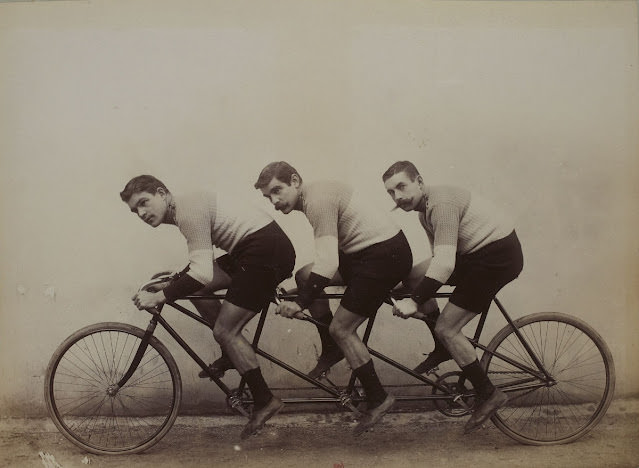
Long before modern pelotons and carbon frames, tandem cycling was already being treated as a serious sport, and Jules Beau’s lens preserves that early competitive spirit with striking clarity. Three riders are arranged on a long multi-seat bicycle, leaning forward in near-identical racing postures that emphasize coordination as much as strength. Their close spacing, matched kit, and focused expressions suggest a discipline where timing and trust were as essential as speed.
The elongated machine itself becomes the star: thin tires, spoked wheels, and a rigid frame built to carry multiple cyclists while keeping the silhouette sleek. Beau’s studio-like backdrop strips away distractions, letting the viewer study the mechanics—handlebars, chain line, and the careful distribution of bodies—like a technical diagram brought to life. Even the riders’ bent elbows and angled shoulders tell a story of early training methods, when aerodynamics was understood through experience rather than wind tunnels.
For anyone interested in cycling history, sports photography, or the evolution of tandem racing, this 19th-century scene offers a vivid entry point. It hints at the era’s fascination with speed, teamwork, and new sporting technologies, capturing a moment when the bicycle was still a modern marvel. Taken together, the photograph and its quiet intensity make a compelling reminder that endurance, synchrony, and competitive ambition have been part of cycling since its earliest days.