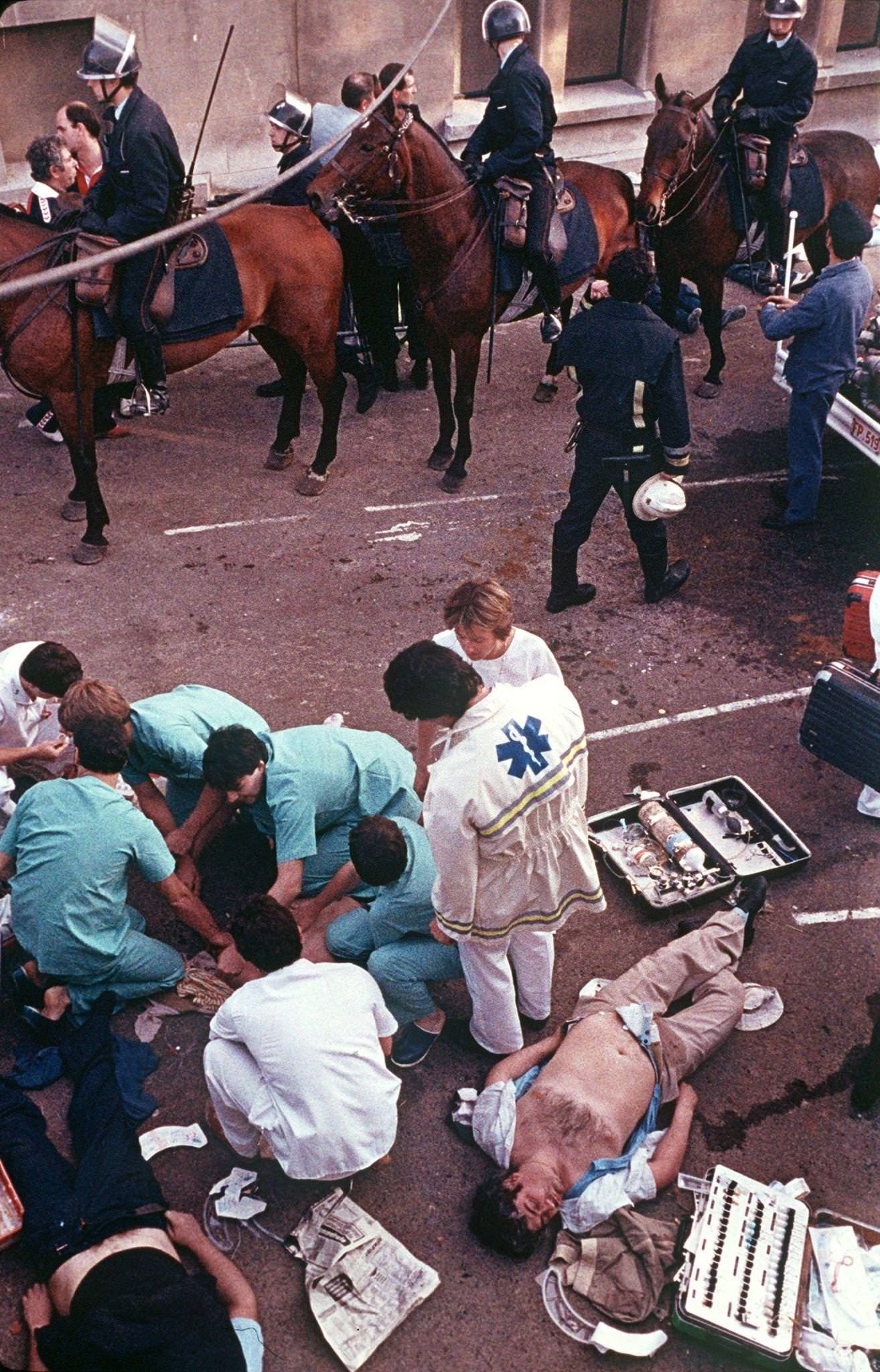
Chaos hangs over the street outside Heysel Stadium as medics in blue uniforms kneel shoulder to shoulder, trying to stabilise victims on the pavement. An open medical case and scattered papers sit beside a man lying motionless, while a firefighter in a white jacket stands watch, caught between urgency and helplessness. Above this improvised triage scene, mounted police form a tense line, their presence underlining how quickly a night of football turned into a mass emergency.
Taken in the wake of the 1985 European Cup Final disaster, the photograph compresses the tragedy into stark, human details: hands searching for pulses, bodies positioned for treatment, equipment laid out wherever there is space. The angle invites the viewer to read the frame in layers—aid workers and victims in the foreground, security and bystanders behind—showing how rescue efforts unfolded amid confusion. It is a reminder that stadium catastrophes are not abstract headlines; they are lived moments measured in minutes and decisions.
Remembered as the Heysel Stadium disaster, the event left 39 people dead and became a turning point for European football and crowd safety. Images like this help explain why the tragedy reshaped conversations about policing, stadium infrastructure, and responsibility at major sporting events. For readers searching the history of the 1985 European Cup Final, this scene preserves the uncomfortable truth of what followed the collapse of order: the relentless work of rescuers and the cost borne by supporters.