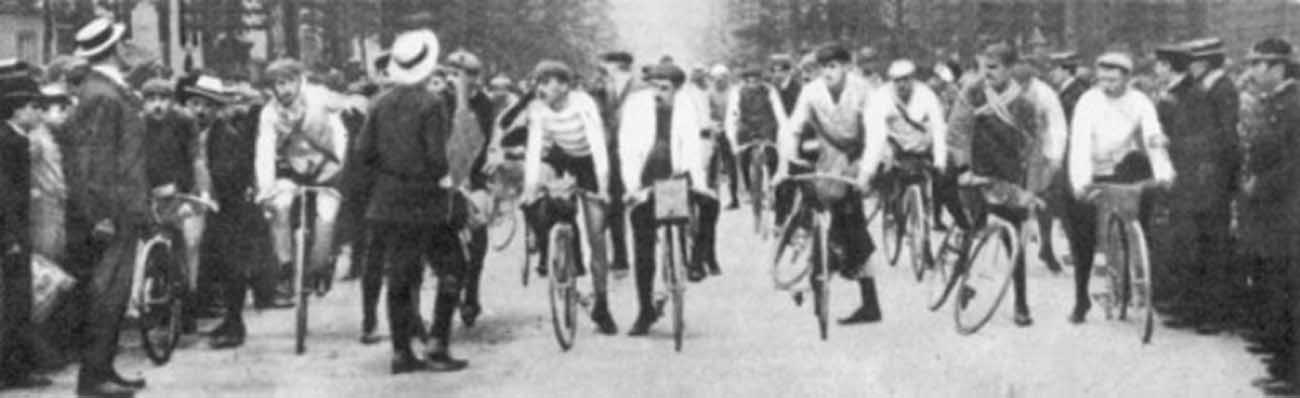
A loose line of cyclists gathers on a broad street, hemmed in by onlookers in dark coats and brimmed hats. The riders sit upright on their machines, some still steadying themselves with a foot on the ground, as if waiting for a signal or a final instruction. Faces blur in the grain of the old print, but the posture and crowding convey that distinctive pre-start hush before endurance and luck take over.
What stands out is how unsettled “proper” cycle clothing still was in the early Tour de France era. Instead of a uniform kit, there’s a patchwork of light shirts, darker trousers, caps, and layers that look borrowed from everyday life as much as from sport. In an age before modern jerseys, helmets, and breathable fabrics, riders experimented in public—dressing for long distance, cold mornings, and rough roads with whatever seemed practical.
Seen alongside other 1903 Tour de France historical photos, this start-line moment helps explain why the race felt closer to an expedition than a polished event. The bicycles appear spare and rigid, the crowd close enough to touch, and the street itself becomes the arena. For readers browsing cycling history, early Tour de France imagery, or the evolution of cycle clothing, the scene offers a vivid reminder that the legend began with ordinary garments and extraordinary ambition.