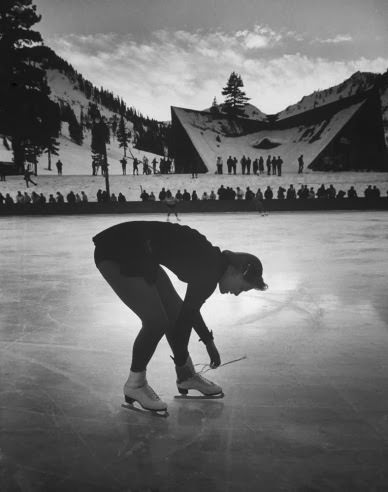
Under a wide winter sky, figure skater Carol Heiss bends low over the ice, hands near her skates as if making a final adjustment before stepping into history. The low angle emphasizes her focused posture and the clean lines of her boots and blades, while the outdoor rink stretches behind her in glassy, reflective tones. In the distance, spectators and officials form a dark band along the boards, their silhouettes reinforcing the hush that often falls just before a decisive performance.
Beyond the rink, the mountain setting at Squaw Valley frames the moment with a dramatic sweep of snow and evergreen ridges, reminding us how distinct the 1960 Winter Olympics felt with events staged in the open air. A large backdrop and clustered onlookers hint at ceremony and pageantry, yet the scene remains intimate—an athlete alone with the ice, preparing for the precise balance of speed, edge control, and poise that defines elite ladies singles skating. The contrast between the vast landscape and the concentrated act of tying things down underscores how championships are built from small, practiced rituals.
For readers searching Olympic history, Carol Heiss, Squaw Valley 1960, and ladies singles gold medal memories, this photograph offers a compelling window into the era’s style and atmosphere. It evokes a time when competitive figure skating combined artistry with athletic discipline, played out under natural light and surrounded by a crowd close enough to feel every pause and push. As a WordPress post image, it works beautifully as both sports documentation and visual storytelling—an iconic champion caught in a quiet, human moment before the spotlight.