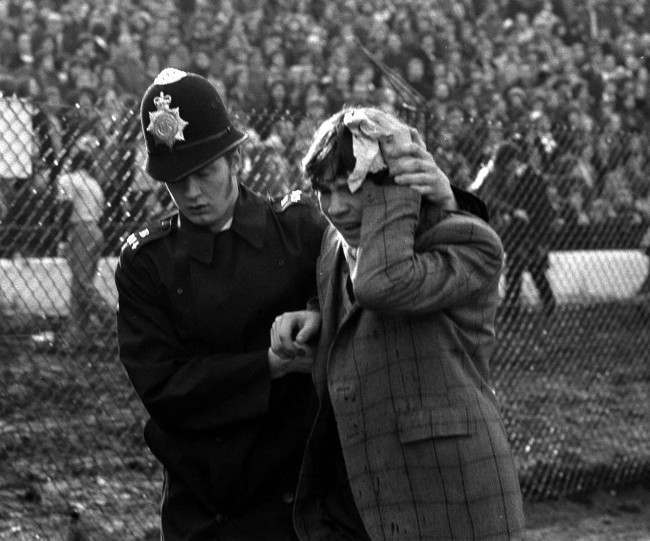
Along the edge of a crowded stadium terrace, a uniformed policeman guides a young supporter who clutches a cloth to an injured head, his body angled inward as if bracing against the noise and the sting. The officer’s steady grip and focused gaze contrast with the fan’s dazed expression, creating a tense, intimate moment amid what was clearly a much larger event. Behind them, a fence and a mass of spectators dissolve into grain and motion, reminding us how quickly a day of sport could turn unpredictable.
The 1970s setting lingers in the details—heavy outerwear, the classic British-style police helmet, and the packed stands that speak to an era when football crowds surged close to the action. Rather than celebrating a victory or a famous goal, the photograph centers on the less-photographed reality of matchday: accidents, scuffles, and the practical work of keeping order. It’s a snapshot of care and authority side by side, capturing how public safety played out in real time.
For readers interested in sports history and vintage football culture, this image offers a human-scale counterpoint to the mythology of the terraces. It invites questions about crowd management, stadium infrastructure, and the everyday risks faced by ordinary fans—especially younger ones—when passion ran high. As a piece of 1970s social history, the scene resonates not because it is dramatic, but because it feels lived-in, immediate, and painfully plausible.