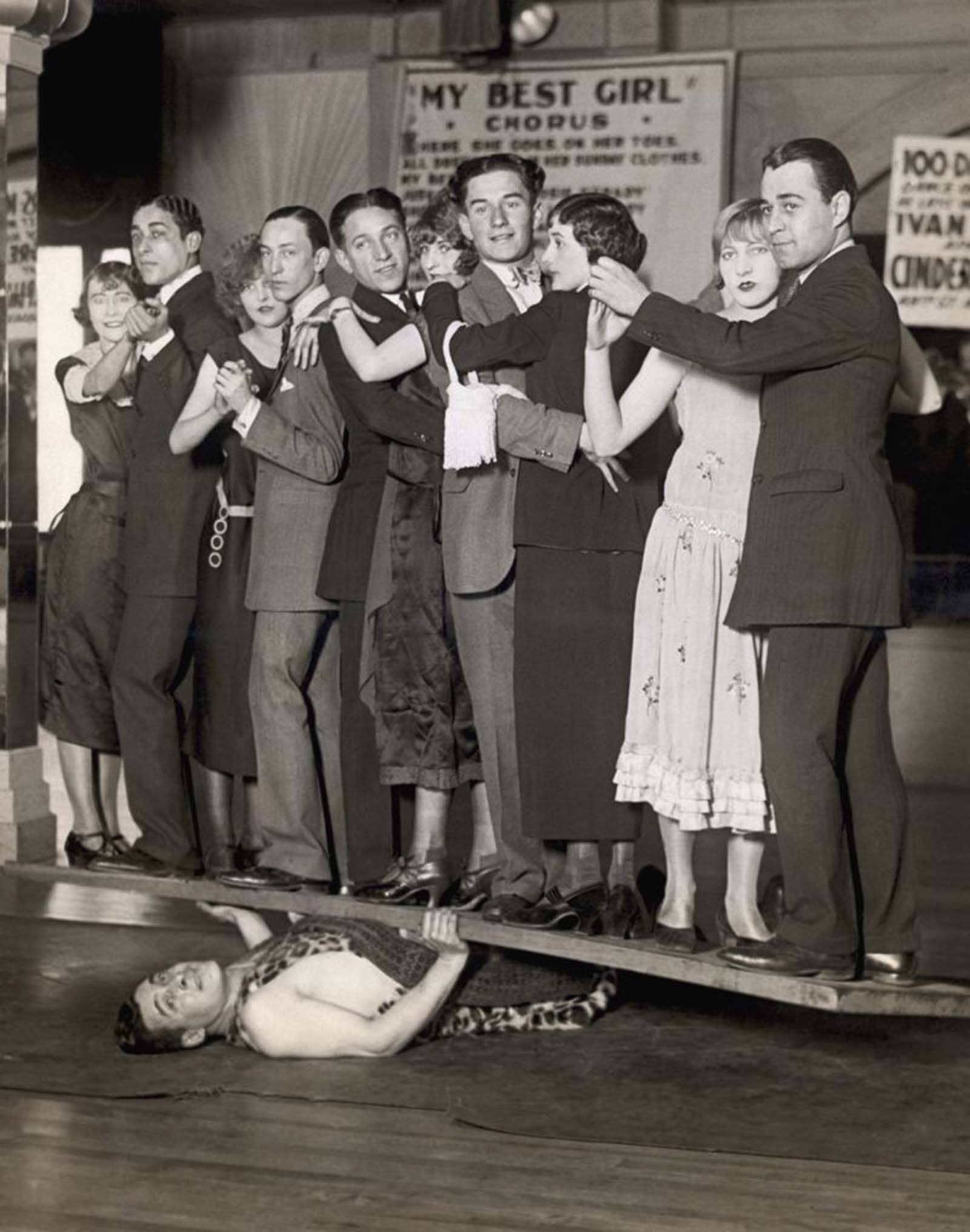
Beneath a long wooden plank, Ivan “The Great” lies braced on the floor, turning his own body into a living support while five neatly dressed couples balance above him. The men’s suits and slicked hair, the women’s bobbed styles and dresses, and the poised ballroom holds create a striking contrast with the strongman’s bare-armed strain. It’s a carefully staged moment from 1924, built for maximum drama: elegance literally resting on brute strength.
Look closer and the scene reads like a snapshot of early 20th-century popular entertainment, where athletic spectacle and social dance could share the same bill. Posters and signage loom in the background, hinting at a lively indoor venue and a public hungry for novelty acts. The couples stand shoulder to shoulder as if mid-step, their expressions ranging from amused to intent, lending the stunt a playful, almost theatrical tension.
As a piece of strongman history, the feat is memorable not only for the weight involved but for the symbolism—human bodies arranged like props in a performance of endurance and control. Ivan’s demonstration belongs to the era when “the world’s strongest” titles were made and reinforced by sensational displays, photographed to travel far beyond the room where they happened. For readers interested in vintage sports photography, vaudeville-era feats, and 1920s physical culture, this image captures the showmanship that helped define the strongman legend.