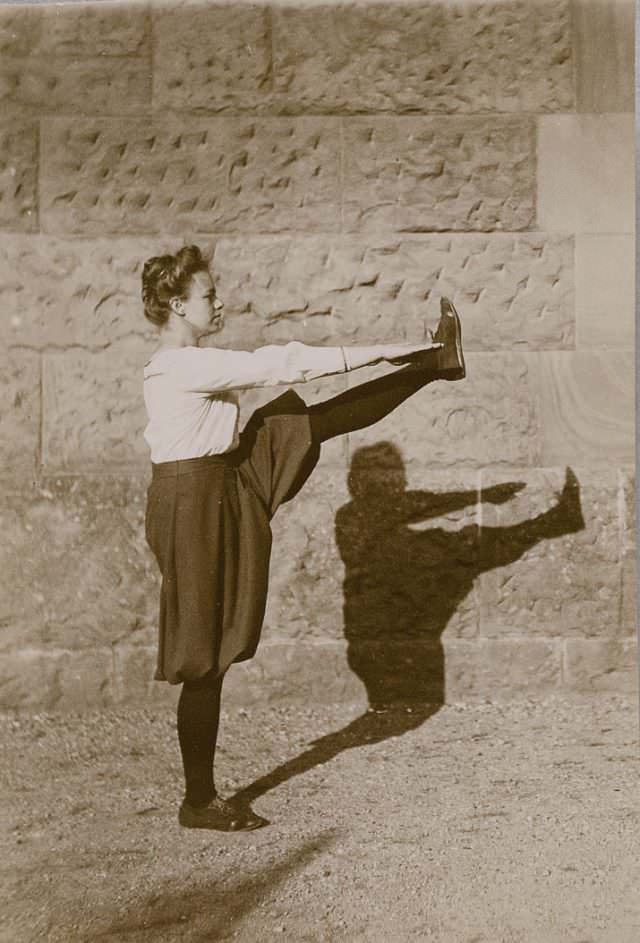
Against a rough stone wall, a young woman holds a controlled leg lift with arms extended, her posture steady and deliberate. The crisp outline of her shadow echoes the movement on the sunlit surface, turning a simple exercise into a striking study of balance, form, and early 1900s athletic discipline. Clothing that reads as everyday—long skirt, stockings, and sturdy shoes—underscores how physical training often fit into ordinary life rather than a dedicated sports uniform.
Swedish gymnastics, known for its structured, health-focused approach, spread across Europe as a modern method of conditioning and posture training. In Heinrich, Germany, the practice suggested in this scene speaks to a growing interest in organized exercise for women, emphasizing precision and controlled motion over spectacle. The photograph’s clean composition highlights the method’s trademark clarity: one body, one movement, carefully held.
For anyone exploring women’s sports history, German physical culture, or the evolution of gymnastics in the 1900s, this image offers a quiet but revealing moment. It hints at how ideas about wellness, strength, and respectable movement were being negotiated and practiced in public view. Viewed today, the pose and its shadow preserve an era when athletic modernity arrived not with grand arenas, but with disciplined routines performed in plain daylight.