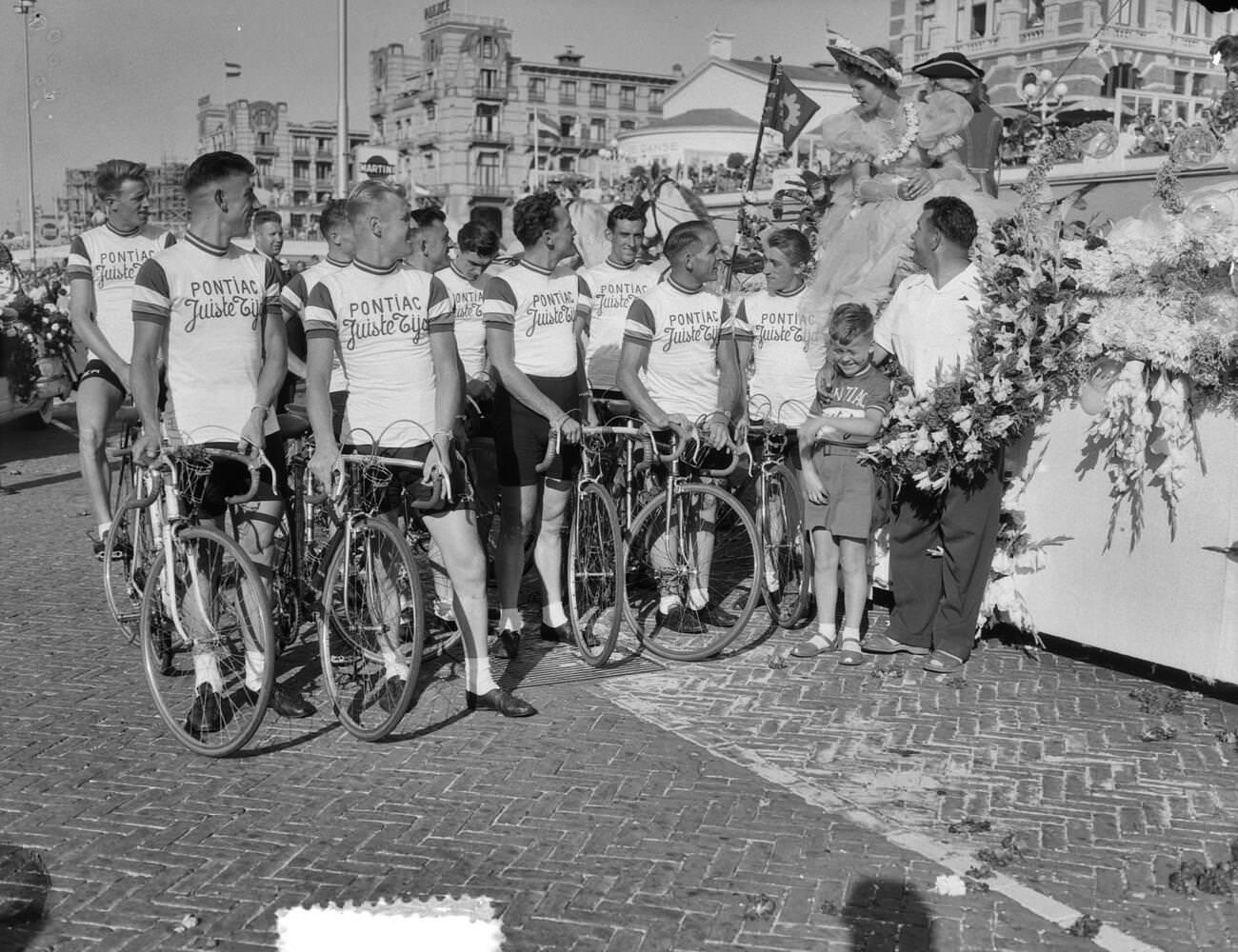
Lined up shoulder to shoulder, a Tour de France squad poses with their road bikes in matching jerseys emblazoned with “Pontiac,” the crisp lettering and simple kit design instantly evoking 1950s cycling style. The riders’ stern, sunlit faces and neatly arranged machines—drop handlebars, slender tires, and metal frames—hint at an era when equipment was elegant, minimal, and unforgiving. Behind them, spectators and city buildings frame the scene, lending the moment the feel of a public ceremony rather than a private team photo.
At the right edge, a flower-laden float and a costumed pair elevate the tableau from sport to spectacle, reminding us how closely cycling and civic celebration were intertwined in mid-century Europe. A small child stands near the team, dwarfed by athletes and decorations alike, a detail that underscores how the Tour de France functioned as a community event as much as a grueling race. The cobbled or brick-paved street underfoot adds texture to the story, suggesting the hard surfaces and rough miles that awaited.
What makes this historical photo so compelling is its balance of discipline and festivity: athletes poised for competition, yet surrounded by pageantry and onlookers. For readers interested in Tour de France history, vintage cycling teams, and 1950s sports culture, the image offers a snapshot of sponsorship, camaraderie, and public enthusiasm in one frame. It’s a reminder that the legend of the Tour has always been built not only on climbs and time gaps, but also on the crowds, the rituals, and the theater of the road.