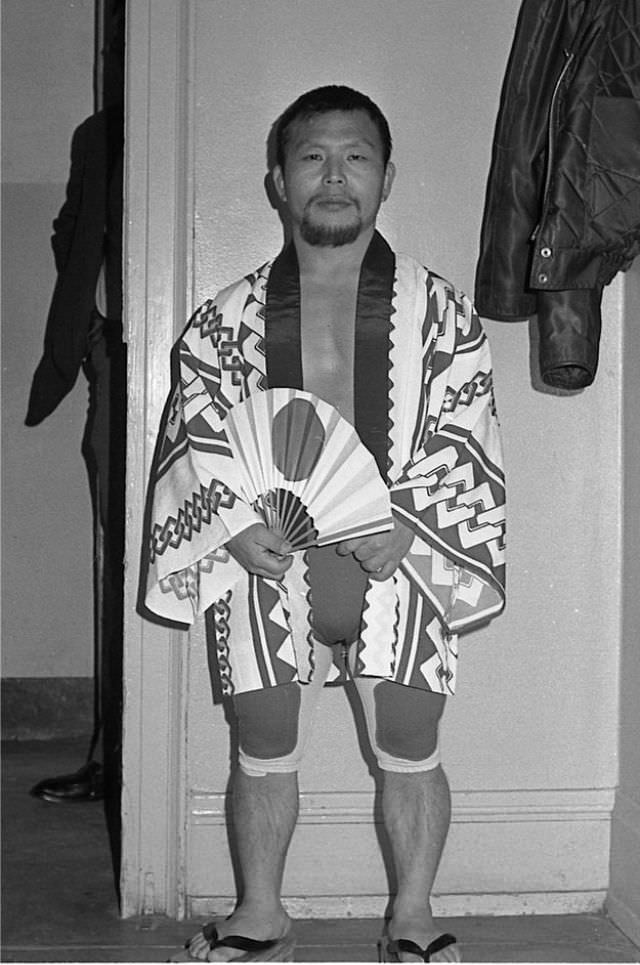
Standing in a plain backstage room, Little Tokyo (also known as Shigeri Akabane) faces the camera with a calm, steady gaze, a folding fan held neatly at his waist. The patterned robe and sandals nod to a Japanese aesthetic that wrestling audiences instantly recognized, while the knee pads and ring-ready stance hint at the athletic reality beneath the character. Even without the roar of a crowd, the portrait carries the quiet confidence of a performer who knew exactly how to command attention.
Behind the nickname is a story tied to wrestling’s traveling troupes and international tours, when visiting stars could spark life-changing decisions. The title’s account of Lord Littlebrook and company touring Japan in the 1960s frames this moment as more than a costume shot—it becomes a snapshot of a wrestler stepping into a new world, bringing heritage and showmanship into an era that thrived on bold personas. The spare doorway, hanging jacket, and hard floor keep the scene grounded in the workaday spaces where wrestlers prepared, endured, and reinvented themselves.
For fans tracing championship lineages, Little Tokyo’s later success as a three-time NWA World Midget Champion—matching Lord Littlebrook’s achievement—adds weight to the image’s understated setting. It’s a reminder that pro wrestling history isn’t only written under arena lights; it’s also preserved in quiet portraits like this, where identity, promotion, and performance meet in a single frame. If you’re exploring classic wrestling photography, midget wrestling history, or the NWA’s sprawling legacy, this post offers a vivid doorway into that world.