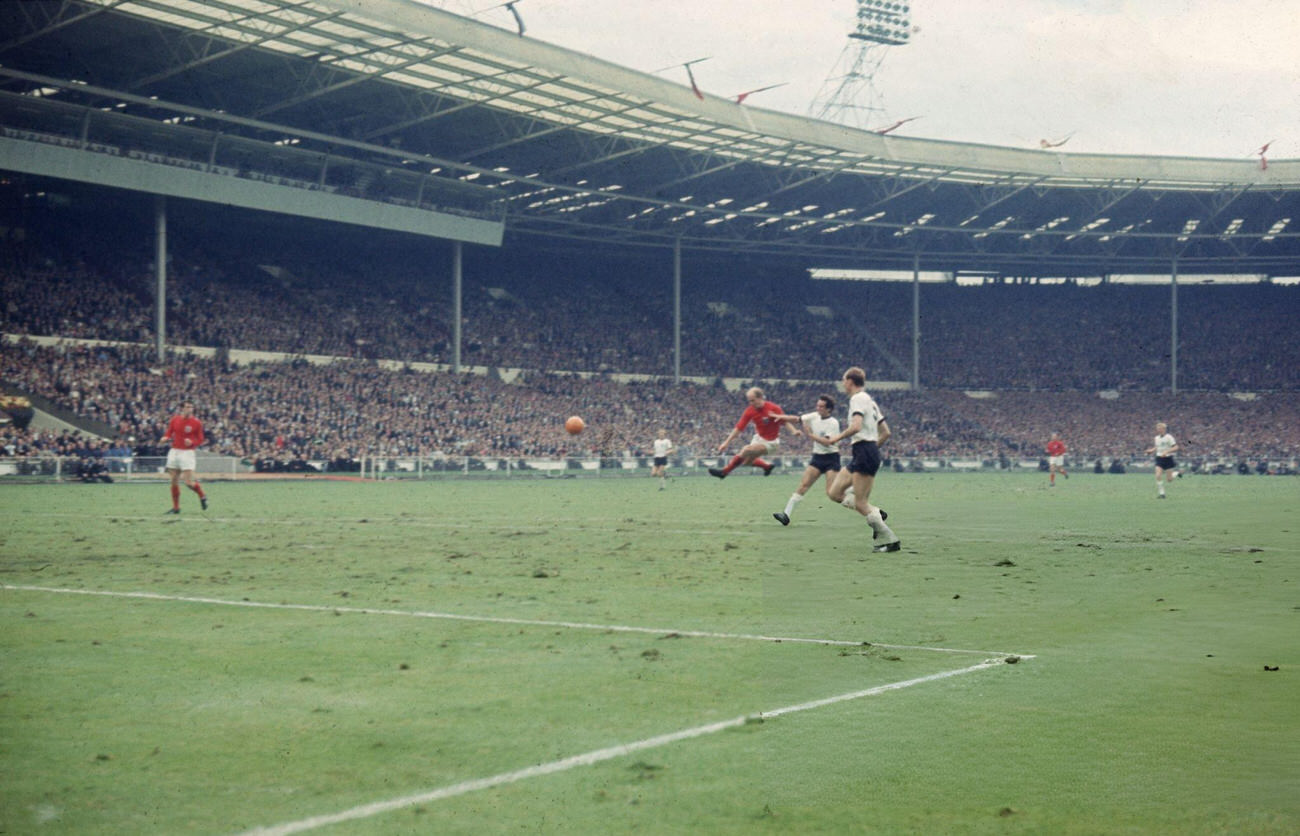
Under the sweeping roof of a packed stadium, Bobby Charlton meets the ball on the volley in the 1966 World Cup Final, his red shirt cutting through a sea of white and dark kits as defenders scramble to close the space. The shot’s low, pitch-level viewpoint pulls you onto the grass itself, where torn divots and scuffed turf testify to ninety minutes of relentless pressure. In the background, terraces heave with spectators, a dense wall of faces that turns the moment into something larger than a single strike.
Charlton’s poised follow-through and the ball hanging just ahead of him capture the fine margins of elite football: timing, balance, and nerve in the loudest arena the sport can offer. Even at a distance, the composition tells the story of a final—players spread across the field, lines of pursuit converging, and the sense that every touch might tilt history. Color film lends a vivid immediacy, preserving the era’s textures: heavy shirts, broad open spaces, and the grand architecture of a mid-century national stadium.
For readers searching for 1966 World Cup Final photography, England’s golden summer, or classic football action shots, this image delivers a clear, dramatic slice of the match’s atmosphere. It’s a reminder of how iconic moments are built from ordinary details: the uneven ground, the tension between attacker and marker, and the crowd’s collective intake of breath as the volley leaves the boot. Seen today, the frame stands as both sports history and cultural memory, freezing a heartbeat from one of football’s most discussed finals.