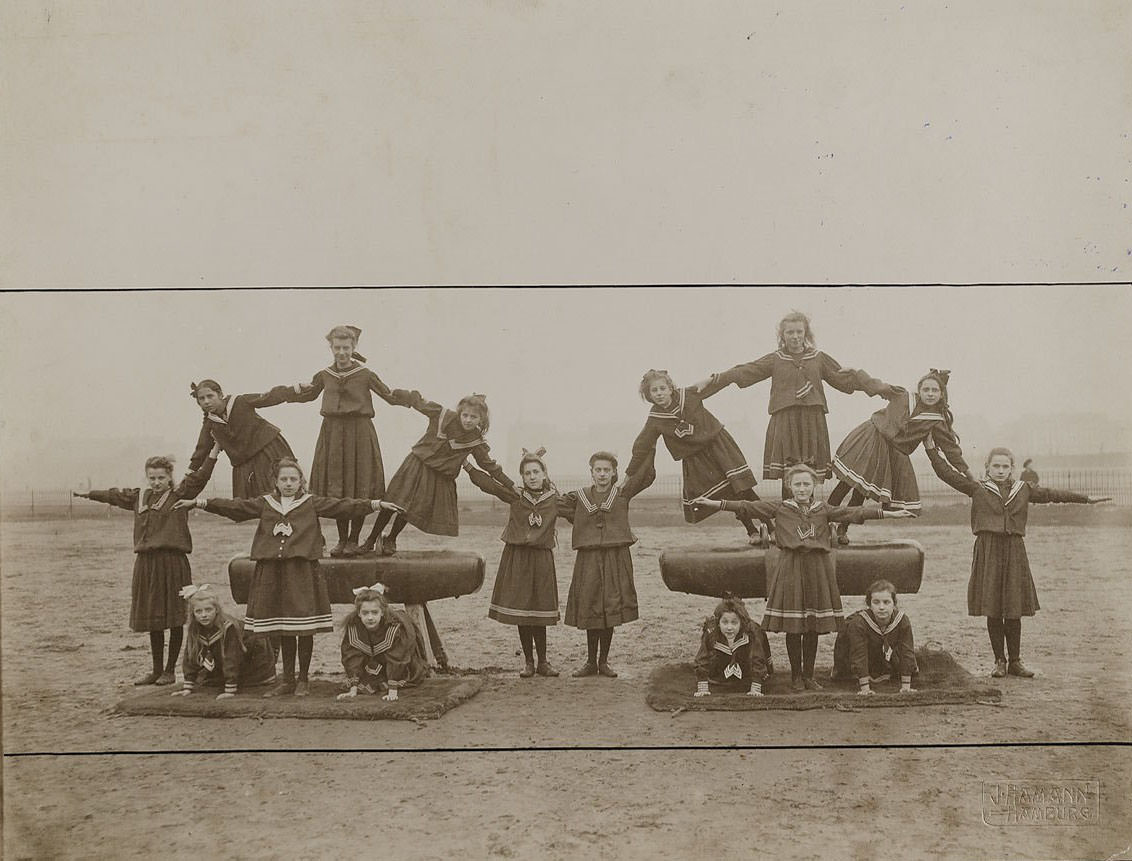
Arranged in a careful, symmetrical formation, a group of German girls holds their arms outstretched in a disciplined display of Swedish gymnastics, balancing across sturdy apparatus set on an open training ground. Their matching sailor-style uniforms and steady expressions lend the scene a school-like seriousness, while the soft horizon behind them keeps the focus on posture, coordination, and control. The composition feels both athletic and ceremonial, capturing a moment when physical culture was performed as much for the camera as for the classroom.
Swedish gymnastics, known for emphasizing orderly movement, balance, and body alignment, appears here as a communal exercise rather than an individual sport. The simple equipment and synchronized poses suggest a structured program—part fitness, part character-building—where uniformity mattered and teamwork was visible in every line of extended arms. Even the stillness of the photograph conveys motion held in check, as if the next command could send the group flowing into another sequence.
Heinrich, Germany, in the early 1900s sits in the background of this image as a reminder that modern ideas about health and training were spreading through local clubs and schools. For historians of women’s sport and youth education, the photo offers a vivid glimpse into how girls participated in organized physical activity, dressed for modesty and practicality while learning strength and coordination. It’s an evocative piece of sports history—one that speaks to discipline, community, and the evolving place of women in public athletic life.