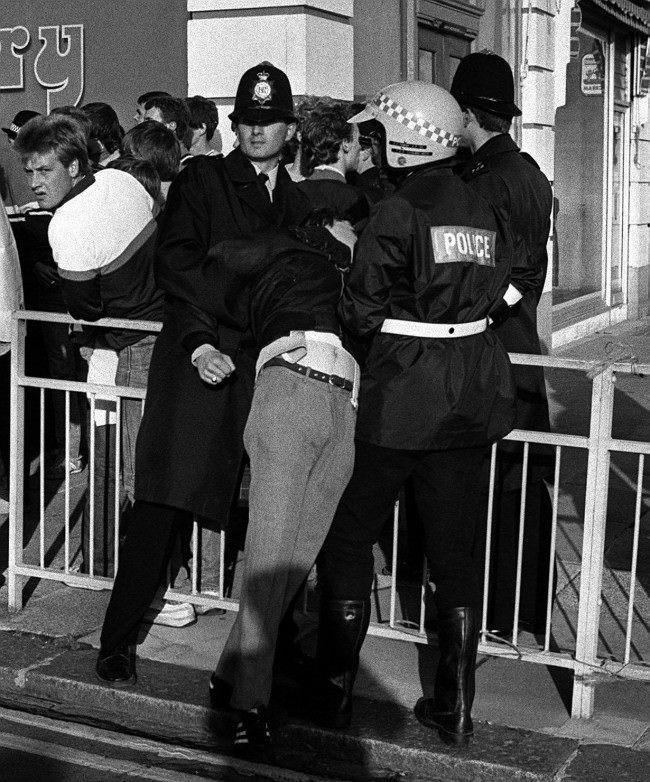
Crowds press against street barriers while uniformed British police hold the line, their helmets, caps, and heavy coats turning the pavement into a tense checkpoint. In the foreground, officers restrain a man bent forward at the waist as onlookers crane for a view, the scene unfolding in the hard midday light outside shopfronts and signage. The stark black-and-white grain heightens the sense of urgency that often surrounded matchdays when tempers spilled beyond the stadium gates.
Britain’s football culture in the 1970s through the 1990s carried a volatile edge, and moments like this reveal how quickly celebration could become confrontation. Police presence wasn’t only about crowd control; it was a visible attempt to manage fear, protect bystanders, and prevent disorder from spreading through city streets and transit routes. Details such as the “POLICE” marking, the waist-high fencing, and the compressed crowd echo the era’s evolving tactics as authorities adapted to recurring bouts of hooliganism.
What lingers is the human texture of the confrontation: faces half-turned, bodies braced, and the uneasy proximity of spectators to force. These vintage photos of British police and football hooligans offer more than sensational conflict—they document public space under pressure and the social anxieties threaded through sport, masculinity, and identity. For readers exploring football hooliganism history, matchday policing, and Britain’s late-20th-century street life, the image is a stark window into how chaos was contained, contested, and remembered.