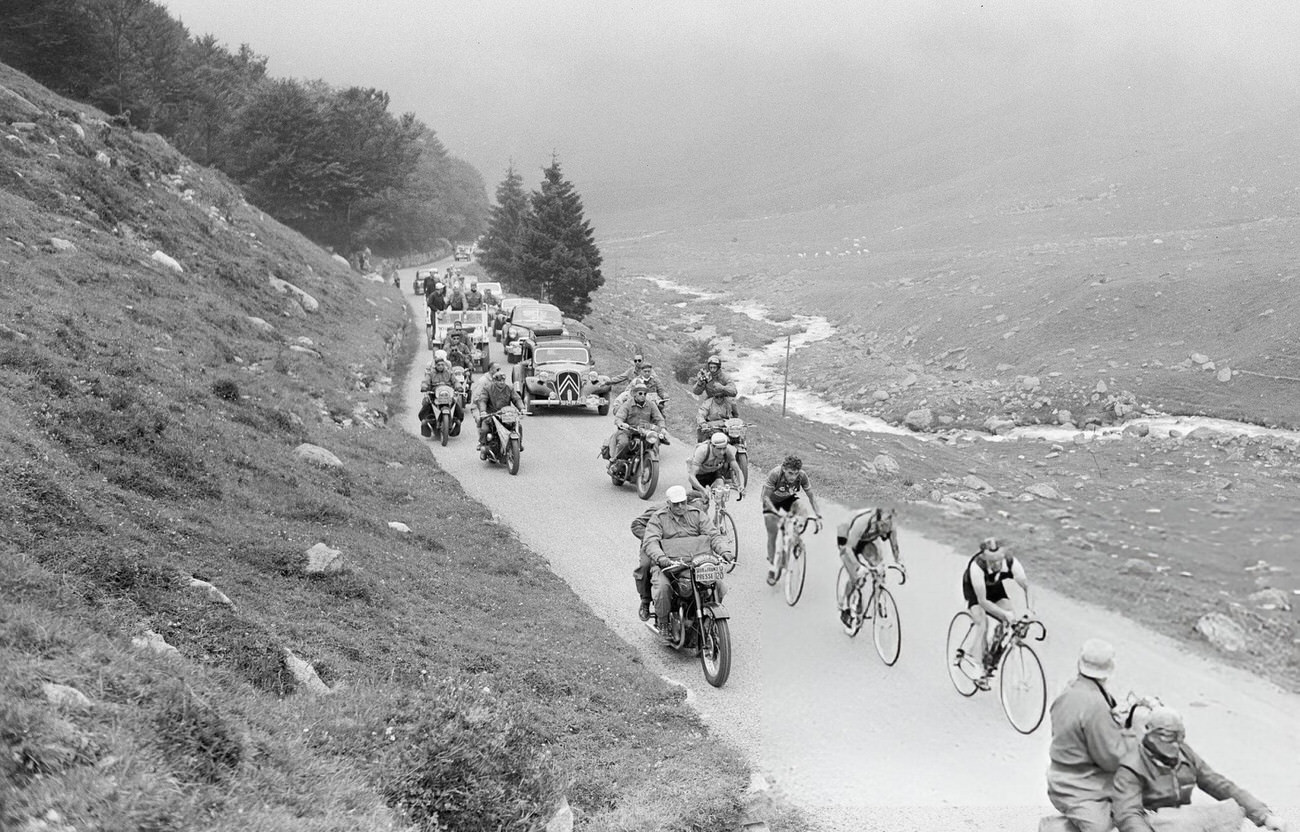
High on the Tourmalet, the road narrows to a ribbon between grassy slopes and a stony valley floor, and the race caravan squeezes through in a long, tense line. In the foreground, Jean Robic drives his bike uphill with shoulders hunched and hands tight on the bars, while other riders hover nearby, each searching for the lightest cadence on a relentless grade. Behind them, motorcycles and team cars crowd the climb, turning the mountain pass into a moving corridor of noise, dust, and effort.
The composition tells a broader story than a single athlete’s struggle: the 1953 Tour de France is visible here as a traveling spectacle, with support vehicles stacked bumper-to-bumper and officials riding close enough to read faces. Sparse spectators appear along the verge, dwarfed by the landscape, as if the Pyrenees itself is the true protagonist. Even without color, the contrasts—dark jackets against pale road, scattered boulders against the smooth curve of asphalt—reinforce the drama of a classic mountain stage.
Robic’s ascent evokes an era when climbing meant raw grit and minimal protection from the elements, and when every switchback offered a chance to gain—or lose—everything. For anyone searching for Tour de France history, Pyrenean cycling legends, or Jean Robic on the Col du Tourmalet, this photograph distills the romance and brutality of grand tour racing into one enduring moment. The pass looks quiet at a distance, yet the clustered machines and straining riders reveal how hard-won every kilometer truly was.