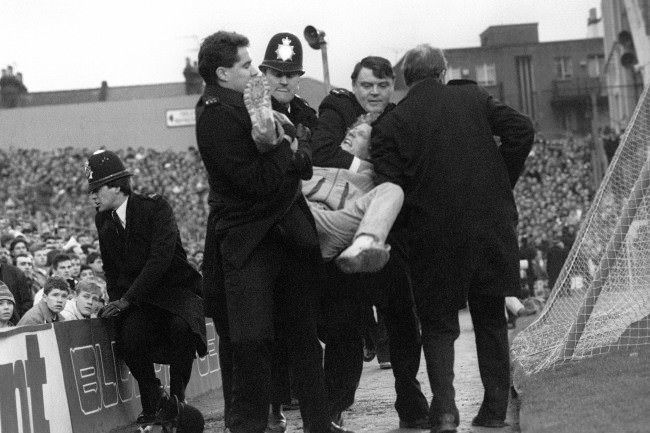
Chaos gathers at pitchside as uniformed officers and stewards hoist a struggling supporter away from the barrier, the crowd behind them packed tight and craning for a better look. A nearby goal net and the edge of the advertising boards place the moment firmly inside a football ground, where the action on the field is briefly eclipsed by a confrontation in the stands. Faces in the terraces read like a cross-section of 1980s matchday life—curious, amused, and wary all at once.
Matchday policing in the 1980s often meant responding in seconds to a surge, a scuffle, or a fan who crossed the line from spectator to participant. The officers’ peaked helmets and the grip of multiple hands speak to procedure as much as urgency, suggesting an effort to regain control without letting the disturbance spread. Even without hearing the roar, you can almost feel the noise pressing in, amplified by the density of supporters and the close quarters along the touchline.
For historians of sport and social life, images like this are invaluable because they document the unglamorous infrastructure of big games: crowd management, authority, and the thin boundary between celebration and disorder. The title, “Police handle a fan who has been pulled out of the crowd, 1980s,” frames it as a snapshot of stadium culture rather than a single incident with a known backstory. It’s a reminder that the era’s football atmosphere was built not only on skill and rivalry, but also on the constant work of keeping thousands of bodies, emotions, and loyalties contained within the same ground.