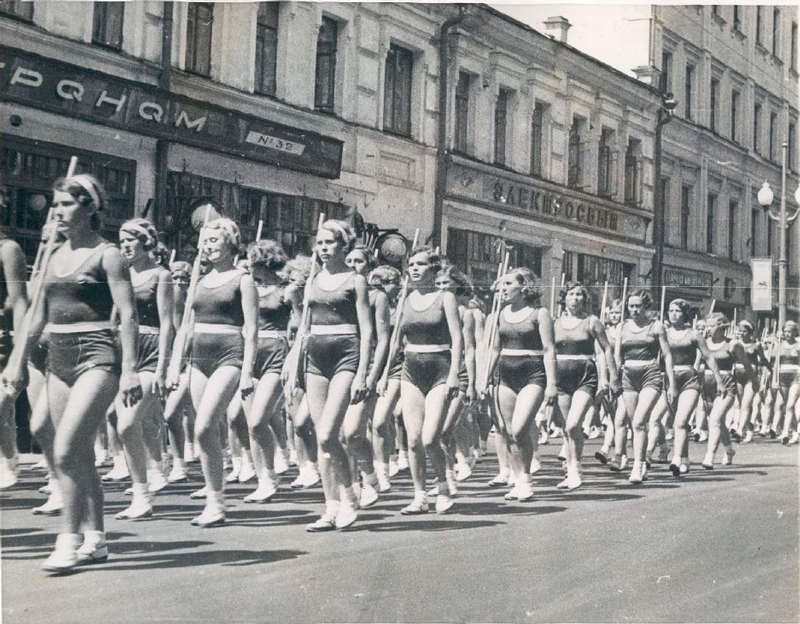
Rows of young women move in step down a broad city street, their identical sports kits and steady posture turning exercise into a public statement. The scene feels like a parade of training—focused faces, squared shoulders, and the rhythm of synchronized marching—set against storefronts with Cyrillic signage and the everyday architecture of an urban Soviet backdrop. Even without a banner in view, the composition echoes the era’s love of mass physical culture and collective display.
In the 1930s, Soviet sport and gymnastics weren’t just leisure; they were tied to ideals of discipline, health, and preparedness, with women prominently included in that vision. Here, the “sport girls” embody the message suggested by the title: strong bodies meant strong will, and strength was meant to be seen. The uniformity of movement and dress suggests organized clubs or state-supported programs, where athleticism doubled as modernity and civic duty.
For readers drawn to vintage Soviet photography, this image offers more than nostalgia—it’s a vivid window into how fitness was staged in public space. Details like the long lines stretching into the distance, the bright daylight, and the onlookers at the edges give the moment documentary weight, capturing sport as spectacle and routine at once. It’s an evocative addition to any collection exploring 1930s Soviet women, physical culture, and the visual language of endurance and unity.