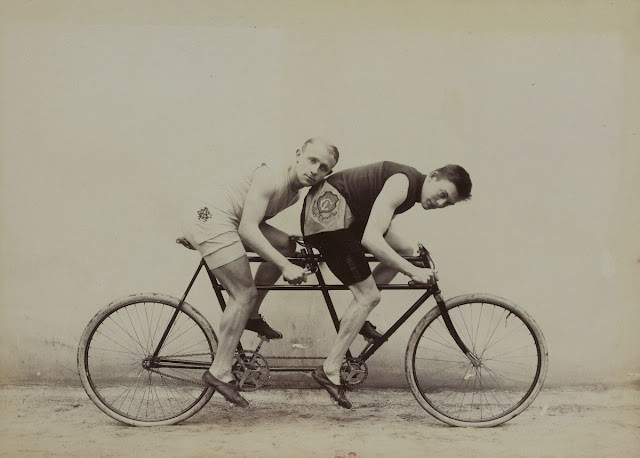
Poised on a long-framed tandem, two riders lean forward in matching concentration, turning a studio-like space into a stage for speed and coordination. The paired bicycle stretches across the frame with its thin tires, spoked wheels, and minimalist geometry—an early sporting machine built as much for efficiency as for spectacle. Their athletic outfits and intent gazes hint at an era when cycling was emerging as a modern obsession, and photographers like Jules Beau helped make its new heroes visible.
Tandem cycling adds a particular drama to the story of 19th-century sport: two bodies, one drivetrain, and no room for hesitation. The front rider’s low, purposeful posture contrasts with the rear rider’s steadier, more upright stance, suggesting distinct roles within a single performance. Details such as the close spacing, shared cadence, and hard, narrow saddle evoke the physical demands of early competition, when endurance and balance mattered as much as raw pace.
Jules Beau’s sports photography doesn’t just document equipment; it preserves attitudes—discipline, camaraderie, and the confidence of athletes presenting themselves to the public. For readers interested in the history of cycling, early tandem racing, or the visual culture of sport, this image offers a crisp reminder of how quickly the bicycle became a symbol of progress. It also fits neatly within broader themes of 19th-century sports photography, where technique and timing—on the track and behind the camera—were both evolving at once.