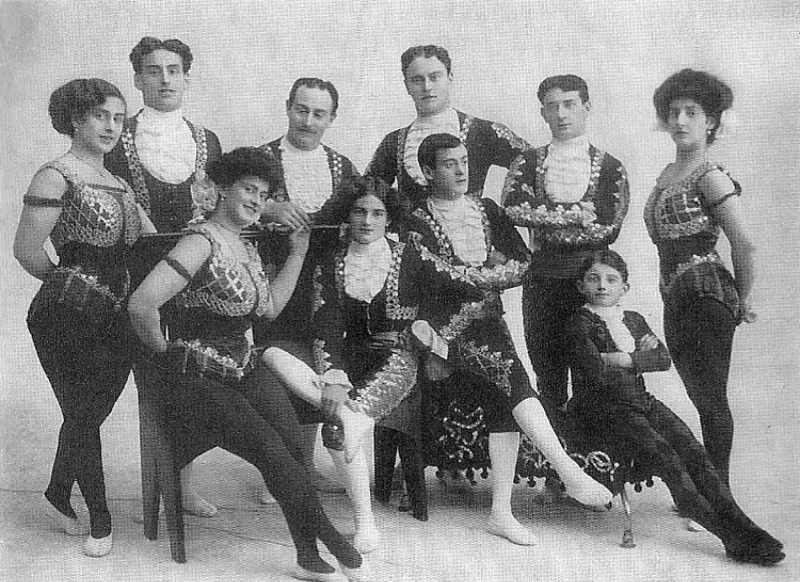
A troupe of poised performers faces the camera in ornate stagewear—men in embroidered jackets and tights, women in fitted costumes with decorative panels—arranged in a carefully balanced studio tableau. The relaxed confidence of their stances, from arms folded to hands on hips, hints at bodies trained for lifts, hand-to-hand work, and precisely timed partnering. Even at rest, they project the quiet tension of acrobatics: strength disguised as elegance.
The title points to the Kremos, a Swiss family whose craft carried across two generations during the late 19th and early 20th centuries, when variety theatres and circus bills prized athletic novelty. Family ensembles were practical as well as marketable—trust, shared technique, and consistent rehearsal could travel as a brand, from posters to playbills. Seen through that lens, the group portrait becomes more than a souvenir; it reads as professional advertising, presenting unity, versatility, and polish to prospective audiences.
Details in the clothing suggest a world where acrobatics met theatrical flair, with embellished trims designed to catch stage light and emphasize line and form. The presence of multiple women and men together, posed like a cohesive company rather than a single star, underscores the collaborative nature of family acrobat troupes in this era. For readers interested in Swiss circus history, early physical culture, and the evolution of performance sports, the Kremos offer a vivid case study in how talent, kinship, and showmanship could travel together.