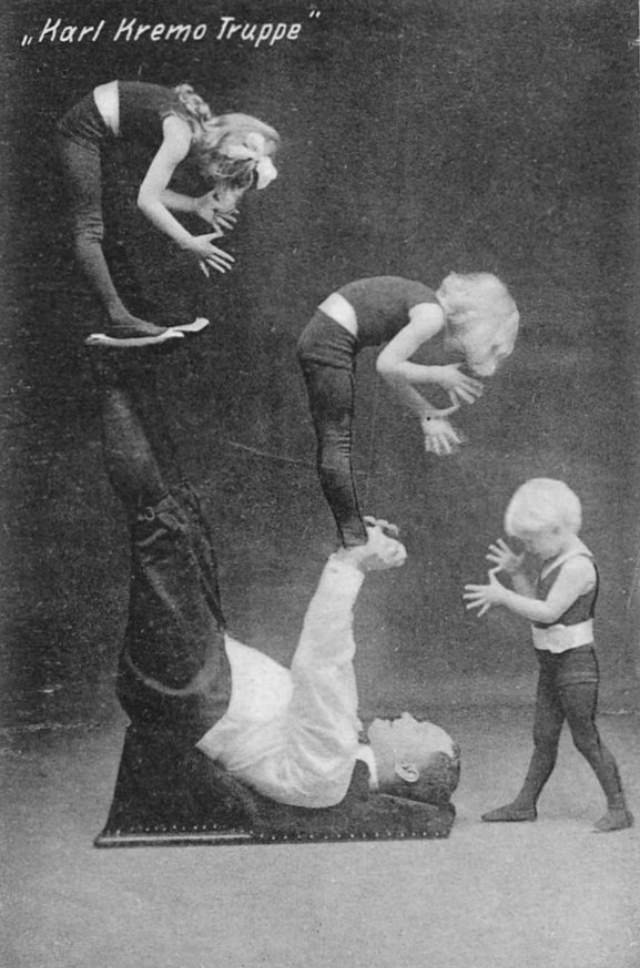
Across a bare stage, the “Karl Kremo Truppe” freezes in a delicate balancing act: an adult performer reclines on a low support, legs raised to hold a child aloft, while a second child steadies themselves on an elevated platform to the left. Their matching outfits and mirrored forward bends create a sense of choreography as much as athleticism, with small hands extended as if feeling for an invisible rhythm. The plain backdrop keeps attention on bodies, balance, and the quiet courage required to trust another person’s footing.
Family troupes like the Kremos thrived in the late 19th and early 20th centuries, when circus and variety stages rewarded precision, novelty, and a reliable ensemble that could travel. In this photograph, the emphasis isn’t on spectacle props but on technique—hand-to-foot support, controlled posture, and the careful spacing that prevents a cascade of mistakes. It’s a glimpse into how acrobatic training could be woven into household life, producing performers across generations through repetition, discipline, and shared craft.
For readers interested in Swiss circus history, early acrobatics, and the evolution of family entertainment, the Kremo story offers an intimate angle on performance culture before modern safety standards and media fame. The image also serves as a reminder that “sports” once lived comfortably beside theater, music, and comedy in the same program, marketed as both art and physical achievement. Look closely and the photograph becomes more than a stunt: it’s a portrait of work, trust, and tradition passed down one balanced moment at a time.