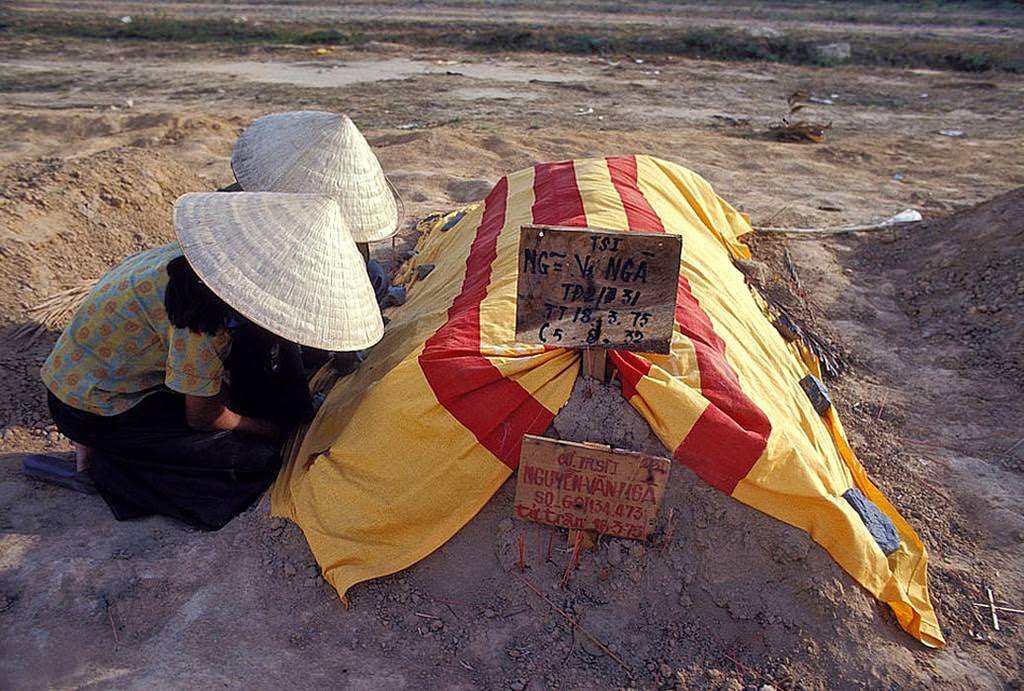
Under a harsh, open sky, two mourners in conical hats kneel beside a fresh earthen mound, their bodies turned inward in a posture that needs no translation. A striped cloth—bright against the dust—drapes the grave like a last, improvised banner, while the surrounding ground stretches out bare and unsettled, hinting at a cemetery pushed to the margins. The scene is quiet but not serene; it carries the unease of an ending that arrived too quickly for proper farewells.
Handwritten wooden markers stand at the head of the burial, their Vietnamese text roughened by dirt and time, offering only partial certainty in a moment defined by confusion. Nothing here feels monumental: no stone, no carved epitaph, just temporary materials pressed into service to hold a name, a unit, a memory. In that stark simplicity lies the human scale of the Vietnam War—loss recorded not in grand speeches, but in hurried signs and the careful touch of survivors.
Saigon’s cemetery, as evoked by the title, becomes more than a burial ground; it becomes a threshold where private grief meets political collapse. The phrase “last South Vietnamese deads” points toward the war’s final days and the people caught in its wake—soldiers, families, and communities forced to mourn amid upheaval. For readers seeking Vietnam War history, this photograph offers a direct, intimate look at remembrance in crisis, and at the fragile ways the living try to keep the dead from disappearing.