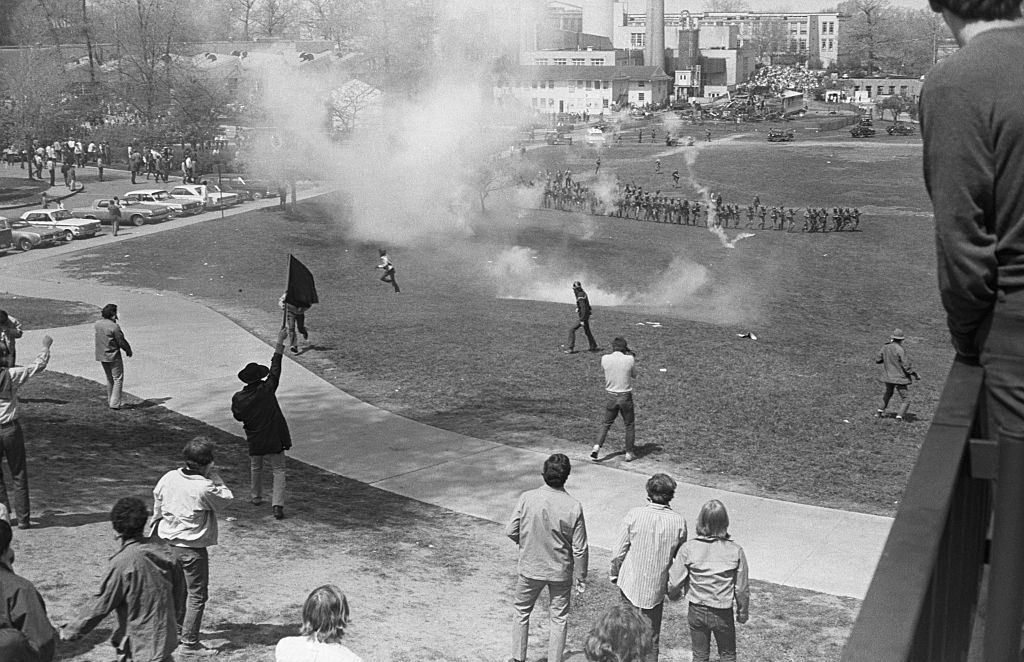
From above, the Kent State University commons reads like a stark diagram of confrontation: a long line of police stretches across the grass while pale clouds of tear gas billow and drift, breaking the open campus into zones of danger and uncertainty. Scattered student protesters and onlookers stand at varying distances, some edging forward, others backing away, the space between them charged with confusion and fear. The aerial perspective makes the scale unmistakable—crowds mass near campus buildings and along the roadway, as if the entire university is holding its breath.
A raised flag in the foreground and figures frozen mid-stride hint at the split-second decisions unfolding across the field, where visibility is literally choked by gas. Parked cars and bare trees frame the scene, grounding this national crisis in an everyday American campus landscape. The tension between order and disorder is visible in the geometry: disciplined ranks on one side, scattered bodies and sudden movement on the other.
Set against the wider backdrop of Vietnam War-era protest, this photograph speaks to how quickly dissent and policing collided in 1970. Readers searching for Kent State May 4th 1970, student protesters, tear gas, and campus unrest will recognize the enduring power of this moment, not as abstraction but as lived experience captured in smoke, distance, and crowd. It’s an unsettling reminder of how a place meant for learning can become a battleground in the struggle over war, authority, and free expression.