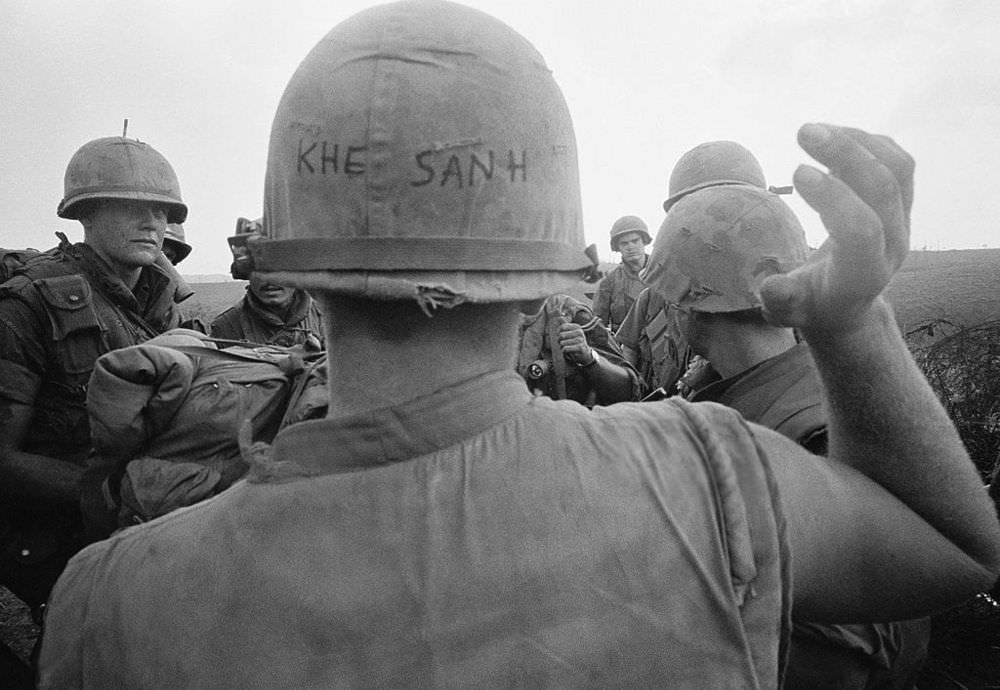
Scrawled across the back of a helmet, the words “Khe Sanh” sit like a blunt label for a place that became synonymous with pressure, waiting, and endurance during the Vietnam War. The photographer frames the scene from within the group, close enough to catch the texture of fatigues and the dull sheen of steel helmets, while an upraised hand and a cluster of faces suggest quick instructions being passed along in the open air.
Around that improvised huddle, the landscape looks spare and wind-worn, with low ground and a washed-out sky that offers little comfort. Packs and gear crowd the foreground, and the men’s expressions—partly shadowed by their helmets—carry the focused, guarded attention of soldiers listening for what comes next. It’s a candid composition that emphasizes proximity: bodies close, voices likely low, movement ready to snap from stillness into action.
For readers searching Khe Sanh history or Vietnam War photos, this image conveys the human scale behind a famous name, where strategy met mud, fatigue, and teamwork. Rather than spectacle, it preserves the in-between moment—communication, readiness, and the unglamorous routines that shaped daily survival. The helmet’s handwritten marker turns the entire frame into a caption, anchoring memory to a single word and the men who carried it.