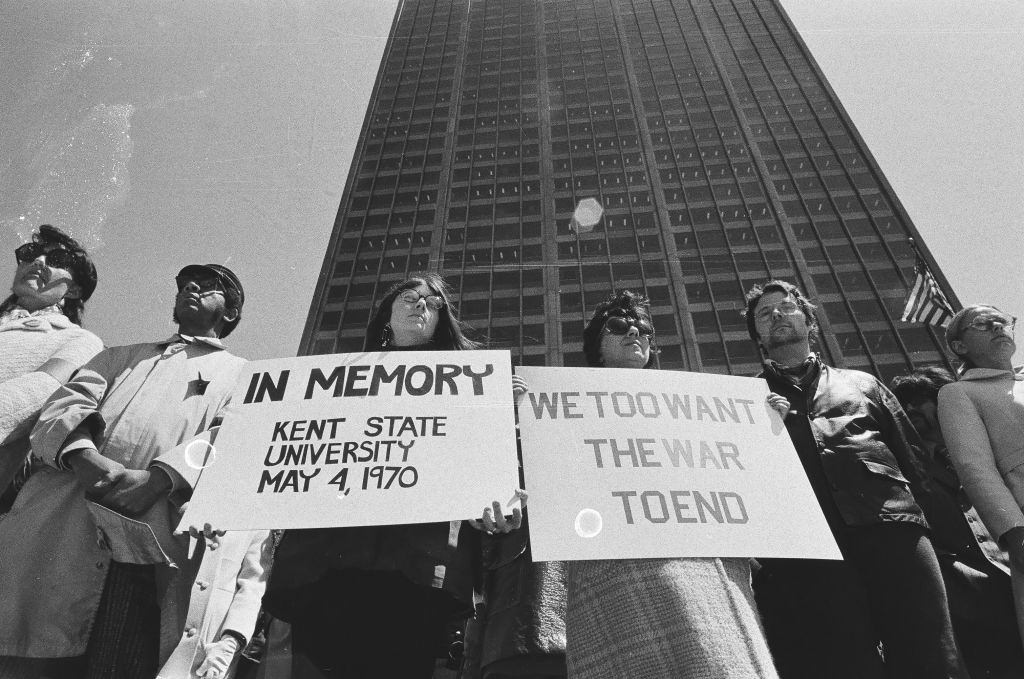
Beneath the sheer face of the Equitable Building at 401 North Michigan Avenue, a line of mourners stands shoulder to shoulder, their bodies small against the vertical grid of windows that climbs into the Chicago sky. The low-angle viewpoint turns the skyscraper into a looming backdrop, emphasizing how public grief unfolded in the shadow of modern corporate architecture. Faces are set and unsmiling, the mood quiet but resolute, as if the city itself has paused to listen.
Hand-lettered and boldly printed signs give the gathering its purpose: “IN MEMORY” and “KENT STATE UNIVERSITY MAY 4, 1970” appear in stark, readable lettering, anchoring the vigil in the aftermath of the Kent State shootings. Another placard pushes from mourning into demand—“WE TOO WANT THE WAR TO END”—linking the memorial to the wider Vietnam War protest movement. The participants’ everyday coats, sunglasses, and casual stance underscore that this was not a staged spectacle but an ordinary crowd insisting on being seen.
Set on Michigan Avenue, the scene captures how national tragedy reverberated far beyond any single campus, drawing Chicagoans into a shared moment of remembrance and dissent. The photograph balances grief with civic expression, showing how memorials and antiwar activism intertwined in 1970 public life. For readers searching the history of Kent State, Vietnam War protests, and Chicago demonstrations, this vigil offers a vivid snapshot of solidarity written in both architecture and cardboard.