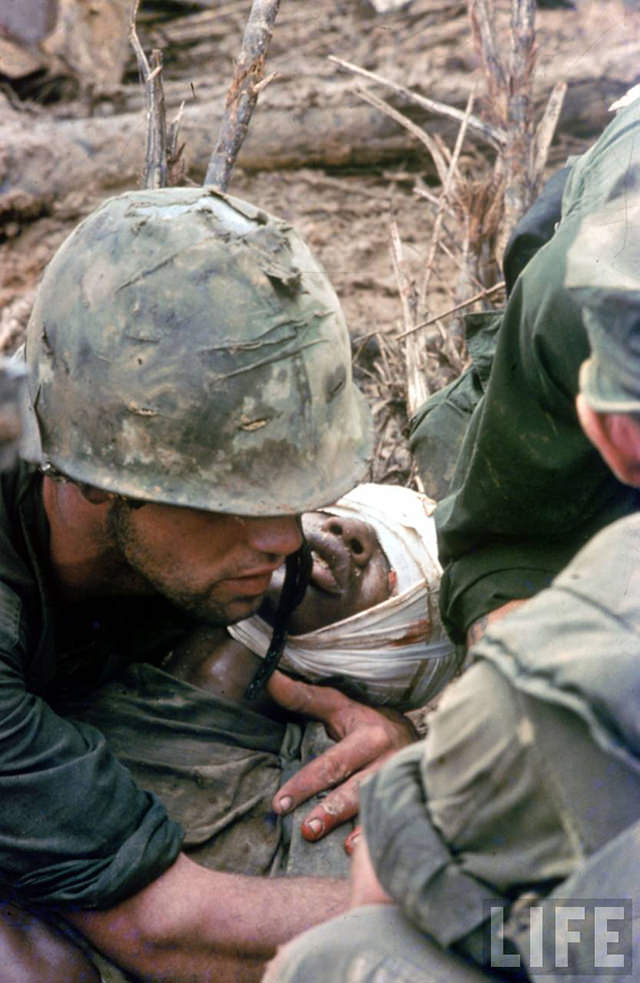
Mud, torn brush, and a low, urgent huddle of uniforms set the scene just south of the DMZ during the Vietnam War. In the foreground, a grimy helmet dips close as one American soldier braces a wounded comrade, the man’s head wrapped in a field dressing and his face slack with exhaustion. Hands press, support, and steady—small, precise movements meant to buy time in a landscape that offers little shelter.
The photograph draws attention to the hard reality of battlefield medicine: improvised care delivered on the ground, under pressure, while the next step depends on an evacuation that cannot be rushed into existence. The soldiers’ posture tells its own story of training and instinct—one keeping the injured man upright, another leaning in to help, all of them focused on breathing, bleeding, and keeping him conscious. Even without seeing the wider perimeter, the tension of waiting is palpable, as if every second is being counted.
As a piece of Vietnam War history, this image reminds viewers that the war’s front lines were often defined less by maps than by moments like this, where survival hinged on teamwork and rapid aid. The setting near the Demilitarized Zone evokes a region known for heavy patrols and sudden contact, making the pause for treatment feel especially precarious. For readers researching American soldiers in Vietnam, combat casualty care, and evacuation procedures, the photo offers a stark, human-scale window into what “awaiting evacuation” truly meant.