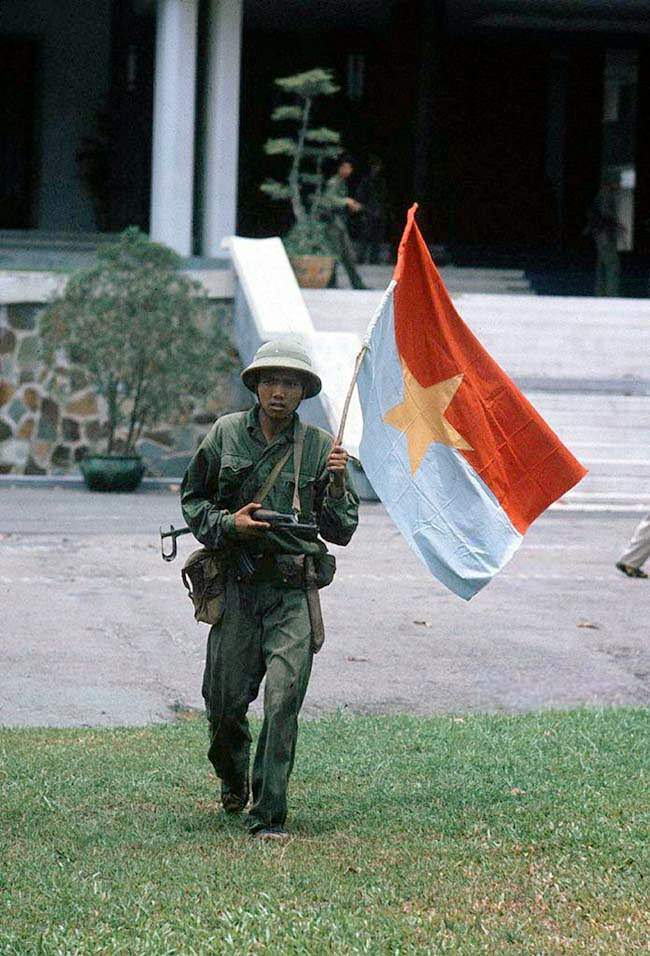
A solitary North Vietnamese officer strides across the palace grounds with a rifle at his side and the G.R.P. flag lifted high, its bright red field and yellow star cutting through the muted tones of uniform and concrete. Behind him, the presidential palace façade—columns, shadowed entryways, and trimmed plantings—frames the moment with an almost formal stillness. The composition balances movement and architecture, turning a single figure into a symbol of a turning page in the Vietnam War.
Dated April 30, 1975, the scene evokes the final hours of a conflict that had reshaped Vietnam and reverberated far beyond its borders. The flag of the Provisional Revolutionary Government carries political weight as much as fabric, signaling authority and transition at the seat of power. Even without a crowd, the posture, gear, and setting communicate that control has shifted and that history is being claimed in real time.
For readers searching for Vietnam War history, the Fall of Saigon, or images from the presidential palace on April 30, 1975, this photograph offers a direct visual anchor. It is as much about atmosphere as outcome: a quiet courtyard, an armed soldier, and a banner held steady amid uncertainty. Details like the palace landscaping and the officer’s field equipment ground the image in lived reality, reminding us that epochal events often arrive on the footsteps of ordinary soldiers.