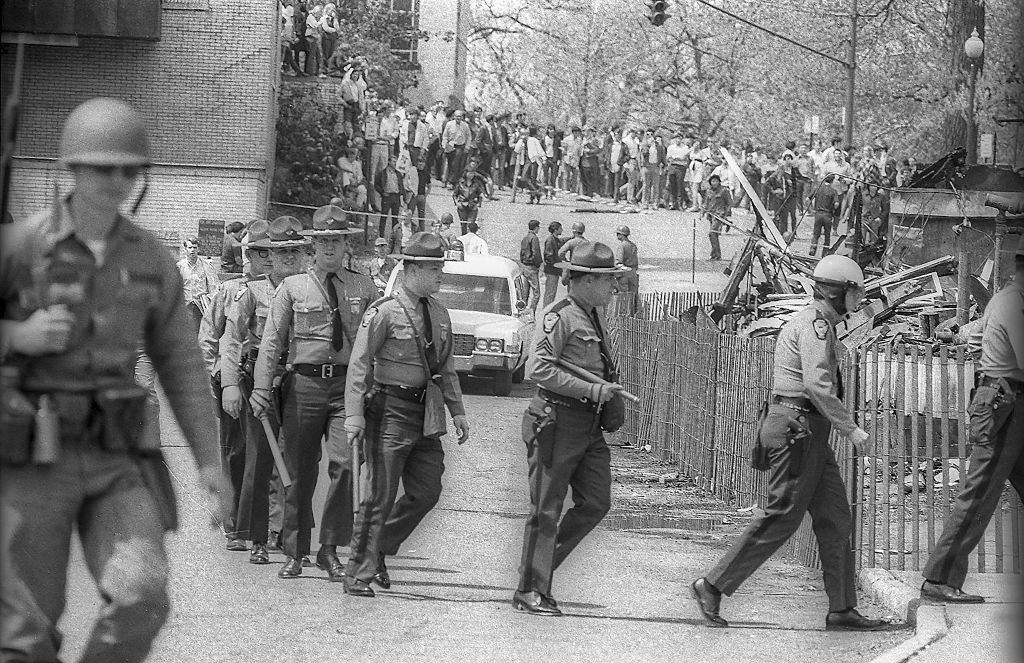
A line of Ohio State Highway Patrol officers advances along a campus roadway, their uniforms crisp and their clubs held ready as they arrive at Kent State University. Behind them, a patrol car sits in the lane, while clusters of onlookers gather on the hill and near a brick building, watching the approach with tense attention. On the right edge of the frame, a tangle of broken boards and debris hints at earlier disorder and the quick unraveling of normal campus life.
The scene speaks to the Vietnam War era’s charged atmosphere, when student protest and public authority repeatedly collided in very visible, very physical ways. Helmets, badges, and batons communicate a posture of control; the crowd’s density and elevated vantage points suggest both curiosity and apprehension. Even without hearing the chants or commands that must have filled the air, the photograph conveys a moment when decision-making narrowed and the stakes felt immediate.
Kent State University remains a powerful keyword in American memory, and images like this one help explain why: they show the buildup, not just the aftermath. Details such as the officers’ measured stride, the spectators lining the slope, and the scattered wreckage on the roadside anchor the story in ordinary objects that suddenly became symbols. For readers searching the history of the Ohio State Highway Patrol, campus unrest, and Vietnam War protests, this photo offers a stark, ground-level view of authority arriving in force.