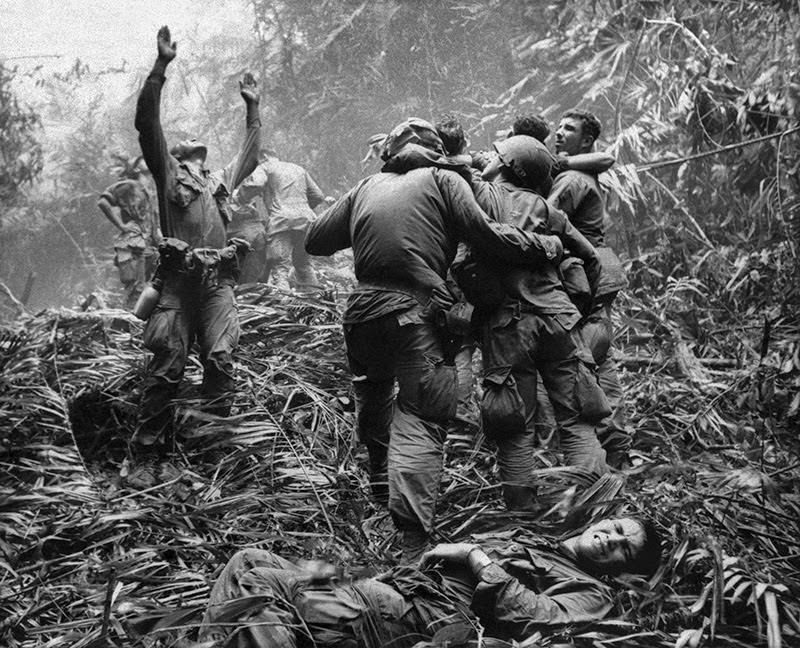
Amid tangled bamboo and shredded undergrowth, a cluster of soldiers strains to carry a wounded comrade through a haze that suggests smoke, dust, or the aftermath of an explosion. One figure throws his arms upward, a raw gesture that reads as warning, disbelief, or desperate signaling, while others look on with tense, searching faces. In the foreground, bodies lie motionless in the debris, forcing the viewer to confront the thin line between evacuation and loss.
Scenes like this explain why Vietnam War photography still grips readers: it documents combat not as strategy but as immediate human crisis. The jungle becomes a claustrophobic battlefield where visibility is short, movement is punishing, and survival depends on the quick coordination of exhausted men. The photo’s chaos—broken vegetation, scattered gear, and compressed space—echoes the broader confusion and brutality that defined so much of the conflict.
For a post exploring 50+ striking Vietnam War photos, this image stands as a stark reminder of how the Cold War struggle between capitalism and communism translated into intimate, bodily suffering on the ground. It invites viewers to slow down and notice the details: the weight of a carried body, the urgency in a turned head, the stillness of those left behind. Taken together with the wider gallery, it helps frame the war’s horror not as an abstraction, but as a series of irreversible moments captured in real time.