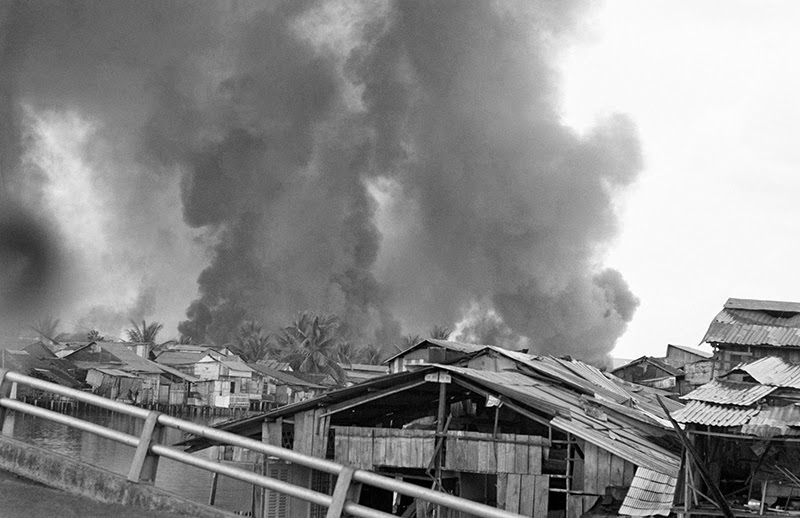
Smoke columns rise behind a low sprawl of tin-roofed homes, turning the sky into a heavy, gray ceiling. In the foreground, a bridge railing cuts diagonally across the frame, as if the viewer has stopped mid-crossing to look back at a neighborhood in crisis. The clustered rooftops and palm silhouettes hint at a tropical urban edge, where ordinary domestic spaces sit uncomfortably close to sudden violence.
What makes the Vietnam War photographs so enduring is how they collapse the distance between battlefield and everyday life, and this scene carries that tension in a single glance. The thick plumes suggest burning fuel, shelling, or an airstrike—cause and perpetrator left outside the frame—while the structures below appear fragile, improvised, and densely packed. Even without visible combatants, the image conveys disruption: a community swallowed by fire and uncertainty, watched from a corridor of transit that might lead to safety or deeper danger.
Within a collection of 50+ striking Vietnam War images, moments like this anchor the wider story of a conflict framed as capitalism versus communism but experienced, relentlessly, at street level. The absence of identifiable faces doesn’t soften the impact; instead it underlines how anonymous suffering can become when destruction spreads across neighborhoods rather than front lines. For readers searching Vietnam War history photos, this photograph stands as a stark reminder that the war’s horror often arrived as smoke on the horizon—and then, suddenly, overhead.