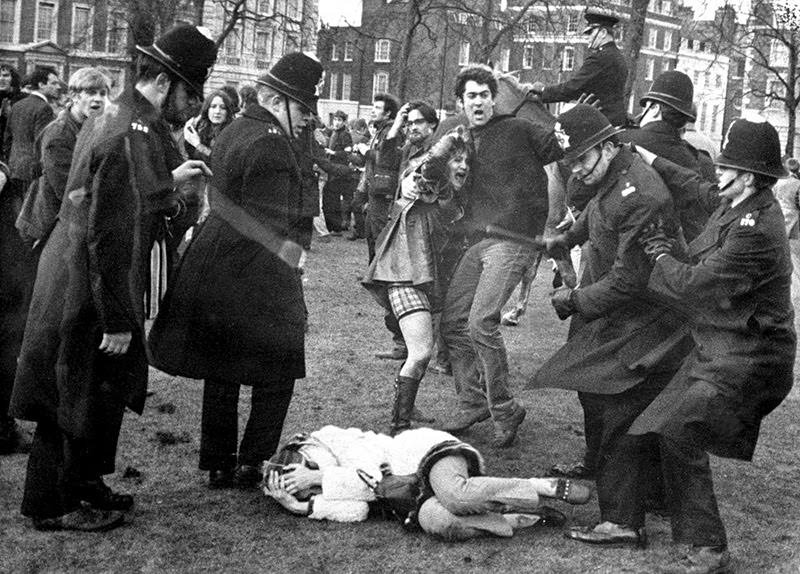
Across a muddy patch of grass, police in rounded helmets surge toward a knot of young protesters while one person lies sprawled on the ground, coat pulled tight against the cold. Faces in the crowd register shock, anger, and fear, and the motion blur of swinging arms and hurried steps makes the scene feel dangerously unstable. Brick buildings and winter-bare trees frame the confrontation, a stark urban backdrop to a moment when public order and public dissent collided at close range.
Although the Vietnam War was fought thousands of miles away, its violence echoed through streets like these, where demonstrations against the conflict drew heavy responses from authorities. The struggle between capitalism and communism became more than a distant geopolitical contest; it shaped everyday life, sharpened generational divides, and turned campuses and city squares into battlegrounds over morality, conscription, and state power. In photos like this, the home front is not calm—it is tense, physical, and painfully immediate.
For readers exploring “The Vietnam War: 50+ Striking Photos Show The Horror Of Bloodiest War Between Capitalism And Communism,” this image adds a crucial layer to the historical record: the war’s social fallout. It’s an unvarnished reminder that the era’s trauma wasn’t confined to jungles and rice paddies, but was also etched into protests, policing, and the fragile line between civic protest and chaos. Taken together with other Vietnam War photographs, it helps tell a fuller story of conflict—one that reshaped politics, culture, and lives on both sides of the ocean.