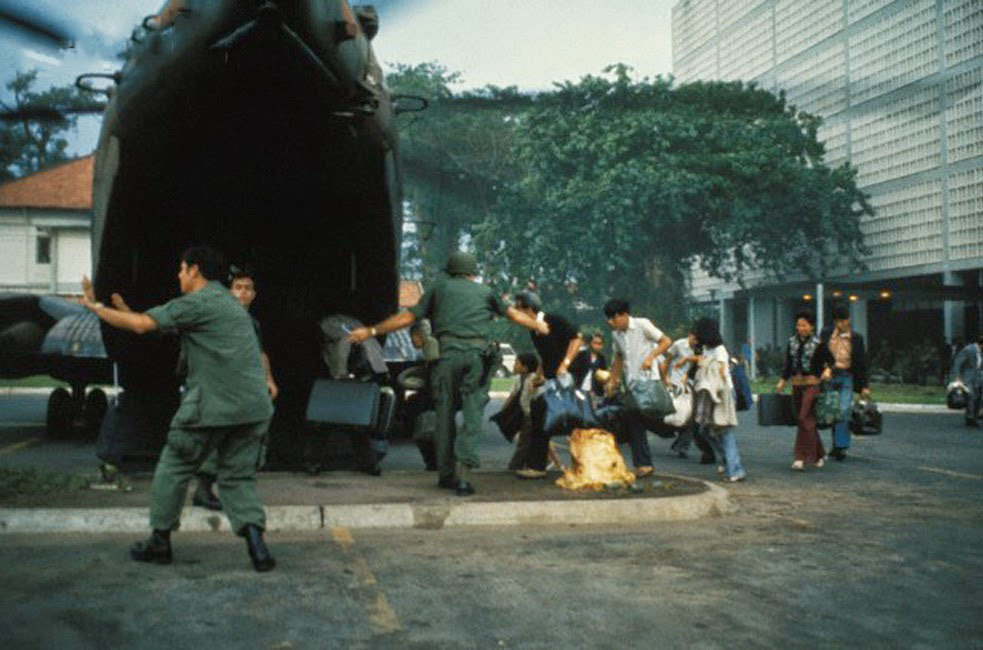
Urgency hangs in the air as civilians hurry across the American Embassy compound in Saigon, arms full of bags and hastily gathered belongings. A helicopter looms in the foreground, its open doorway turned into a narrow passage between safety and the unknown, while uniformed personnel gesture and guide people forward. The scene compresses the end of the Vietnam War into a single, crowded moment—movement, noise, and fear translated into blurred steps and tense faces.
Along the pavement, luggage clusters and scattered parcels hint at lives interrupted mid-routine, reduced to what can be carried in a sprint. The embassy grounds, normally a controlled diplomatic space, become a makeshift evacuation point where order is improvised on the fly. Even without visible combat, the pressure of advancing North Vietnamese forces is palpable in the quickened pace and the way everyone’s attention converges on the aircraft.
Within the wider story of Saigon’s fall, images like this have come to symbolize the chaotic final hours and the human cost of geopolitical decisions. For readers searching Vietnam War history, Saigon evacuation photos, or the American Embassy helicopter airlift, this frame offers more than a dramatic tableau—it invites reflection on what departure looks like when it is forced, fast, and final. In the background of concrete and trees, a city waits as history turns its page.