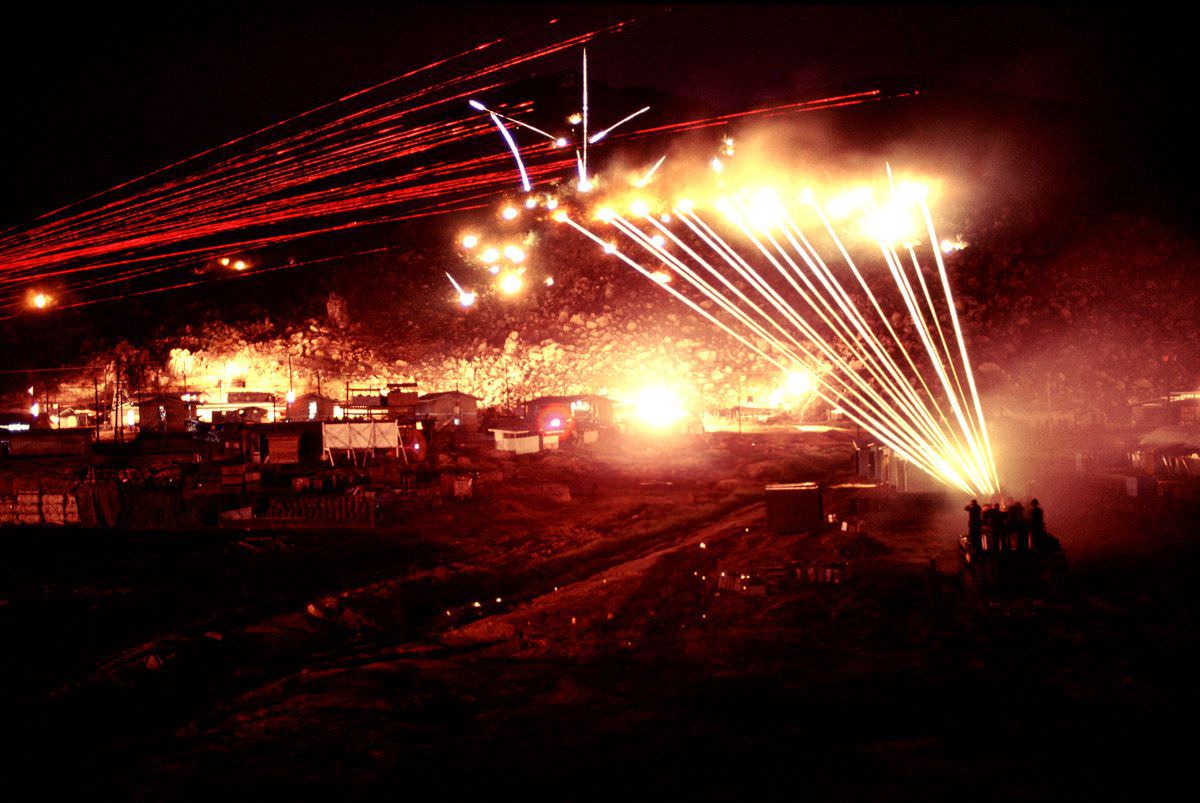
Streaks of tracer fire carve bright arcs across a dark Vietnam War sky, turning a defensive position into a lattice of light and smoke. In the foreground, the silhouettes of troops cluster around a firing point as long, continuous streams of rounds reach outward, while the hillside beyond flickers with bursts and glare. The contrast between the deep night and the incandescent lines makes the scene feel both distant and immediate, like a moment frozen at the edge of chaos.
Under the title “M60 machine guns join the .50-caliber fire,” the photograph reads as a study in layered firepower, with multiple weapons contributing to a single curtain of suppression. The heavier .50-caliber presence suggests sustained defensive or perimeter fire, and the addition of M60 machine guns hints at a coordinated response where volume and coverage mattered as much as accuracy. Light blooms, drifting haze, and the glowing trails capture not just action but the relentless tempo of night fighting.
For readers searching Vietnam War history, this image offers a visceral look at how bases and outposts could transform after dark—quiet ground suddenly alive with coordinated bursts, illumination, and overlapping fields of fire. It also underscores the photographic challenge of the era: long exposures and bright tracers producing dramatic, almost abstract lines that nonetheless record real tactics and real urgency. The result is a powerful wartime photograph that speaks to the technology, doctrine, and human presence behind the battlefield’s luminous streaks.