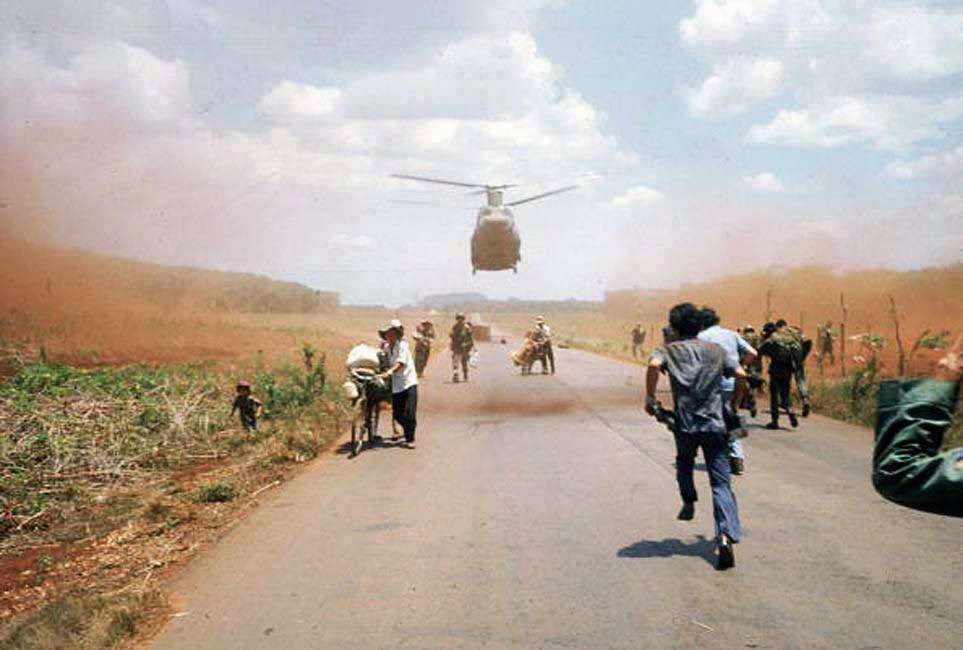
Rotor wash hangs in the air as a helicopter descends toward a straight stretch of road, turning an ordinary roadway into an improvised landing zone during the final days of the Vietnam War. Figures on foot and on bicycles move toward the aircraft, some breaking into a run while others pause with bundles and belongings, caught between urgency and exhaustion. The wide, dusty landscape and low vegetation emphasize how exposed and uncertain this moment felt for South Vietnamese civilians trying to flee as Saigon’s fall drew near in April 1975.
Along the roadside, the scene reads like a corridor of flight: people scattered in small clusters, a few looking back, others focused on the chance of evacuation. The helicopter’s silhouette dominates the center of the frame, a symbol of U.S. military involvement and a lifeline for those seeking escape. Dust and haze soften the distance, hinting at the confusion and pressure that defined evacuation efforts as routes clogged and time ran out.
For readers searching for the history of Saigon April 1975, U.S. helicopter evacuations, or the human experience of the war’s end, the photograph offers a stark, ground-level view of displacement. It captures not strategy or speeches, but movement—families and individuals making split-second decisions on a road that could lead to safety or separation. In a single color image, the last chapter of the conflict is distilled into a fragile meeting of civilians, machinery, and the thin promise of departure.