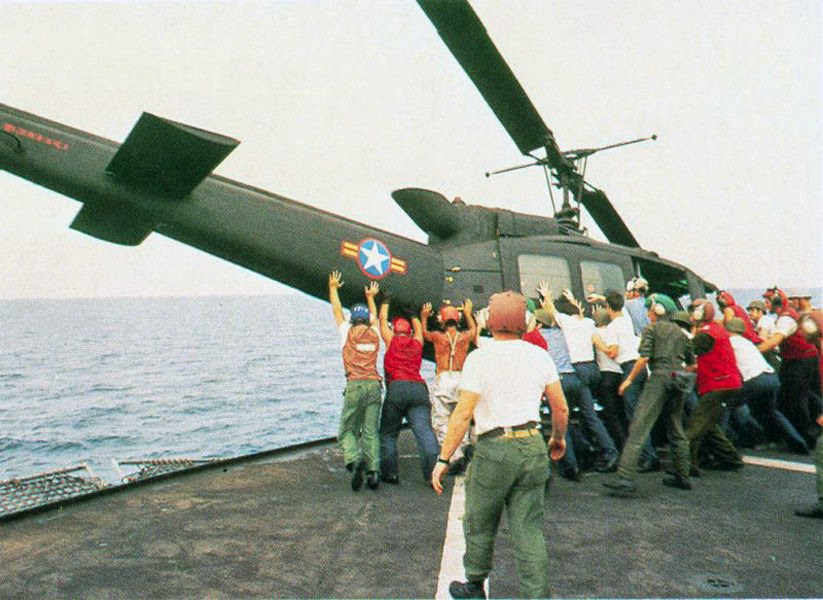
A crowded flight deck heaves with motion as sailors and crew strain shoulder-to-shoulder against a South Vietnamese UH-1H Huey, guiding the helicopter toward the ship’s edge. The ocean sits calm beyond the rail, a stark contrast to the urgent choreography on the deck, where every hand seems enlisted in the same grim task. Visible insignia on the fuselage anchors the scene in the Vietnam War era, when aircraft were as much lifelines as liabilities in moments of crisis.
Pressure drove decisions that feel unthinkable in peacetime: sacrificing a valuable helicopter to clear space for a smaller aircraft—the Cessna O-1—attempting to land. The title’s claim of “being pushed overboard” reads like a blunt summary of desperation, and the image backs it up with the unmistakable posture of people bracing, shoving, and managing weight on a rolling surface. It’s a rare glimpse of how naval aviation sometimes depended less on machinery than on rapid improvisation and collective muscle.
For readers searching Vietnam War photos, Huey helicopter history, or dramatic aircraft carrier deck scenes, this frame delivers an unforgettable story in a single moment. The UH-1H—iconic for troop transport and medevac—appears here not as a symbol of mobility, but as an obstacle that must be removed to save what can still be saved. What lingers is the human scale of the event: ordinary crew members making an extraordinary choice, with the sea waiting just a few steps away.