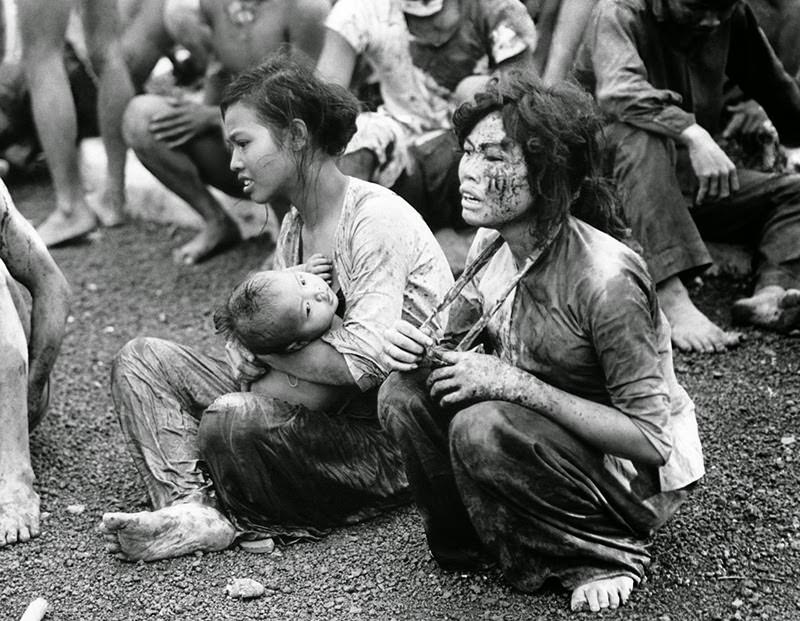
Mud-streaked and exhausted, two women sit on rough ground amid a crowd of other survivors, their bodies slumped in the posture of people who have run out of places to run. One cradles a baby against her chest, eyes distant and unfocused, while the other grips a small object in her hands, her face and clothing marked by soot and grime. Bare feet, torn fabric, and the press of figures in the background turn the scene into a dense tableau of displacement—war reduced to a moment of waiting and shock.
What makes images like this so devastating is how little “battlefield” they contain and how much civilian suffering they reveal. The Vietnam War is often framed through ideology—capitalism versus communism, strategy versus counterstrategy—but photographs like these pull the conflict back to its human scale: families scattered, homes abandoned, lives interrupted in mid-breath. In the grain and harsh contrast of wartime photography, fear becomes visible, not as an abstract statistic, but as a lived condition shared by women and children alongside the wounded and the fleeing.
Taken together with the rest of this collection of Vietnam War photos, the picture serves as a reminder of why the conflict remains one of the most searing chapters of the twentieth century. It documents the aftermath rather than the spectacle, the costs rather than the slogans, and it invites viewers to look past rhetoric to the people caught in the middle. If you’re searching for striking Vietnam War images that confront the horror of the era, these photographs offer an unflinching record of what violence leaves behind.