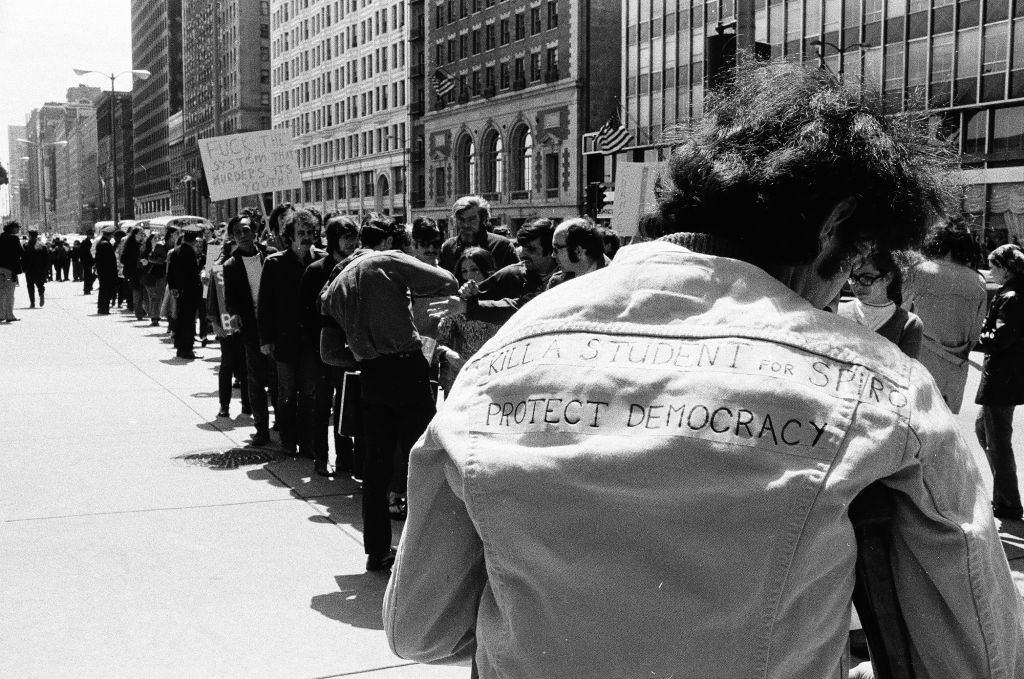
On a downtown Chicago sidewalk, a long line of university students stretches past the walls of tall office buildings, their bodies forming a quiet but unmistakable statement of dissent. In the foreground, a young protester’s jacket bears a hand-lettered message—“KILL A STUDENT FOR … PROTECT DEMOCRACY”—a bitter, urgent critique that connects the Vietnam War to the violence at Kent State. The crowd’s posture and the compressed urban canyon of the street underscore how public space became a stage for conscience in May 1970.
Signs rise above heads further down the line, mixing anger with pleading, and the words are aimed as much at bystanders as at officials. The mood here is not celebratory; it feels tense, purposeful, and heavy with the shock that followed the Kent State University shooting. Captured in the midst of the antiwar movement, the photo records a moment when student activism and grief merged into disciplined protest.
Chicago, Illinois, on May 5, 1970, sits at a crossroads of American history: a major city witnessing how the Vietnam War fractured trust in government and redefined political engagement for a generation. This image is a vivid document of 1970s student protests, anti–Vietnam War demonstrations, and the nationwide response to Kent State, rendered not through speeches but through handwritten slogans and steadfast presence. For readers searching the era’s turning points, it offers a street-level view of how dissent looked, sounded, and endured.