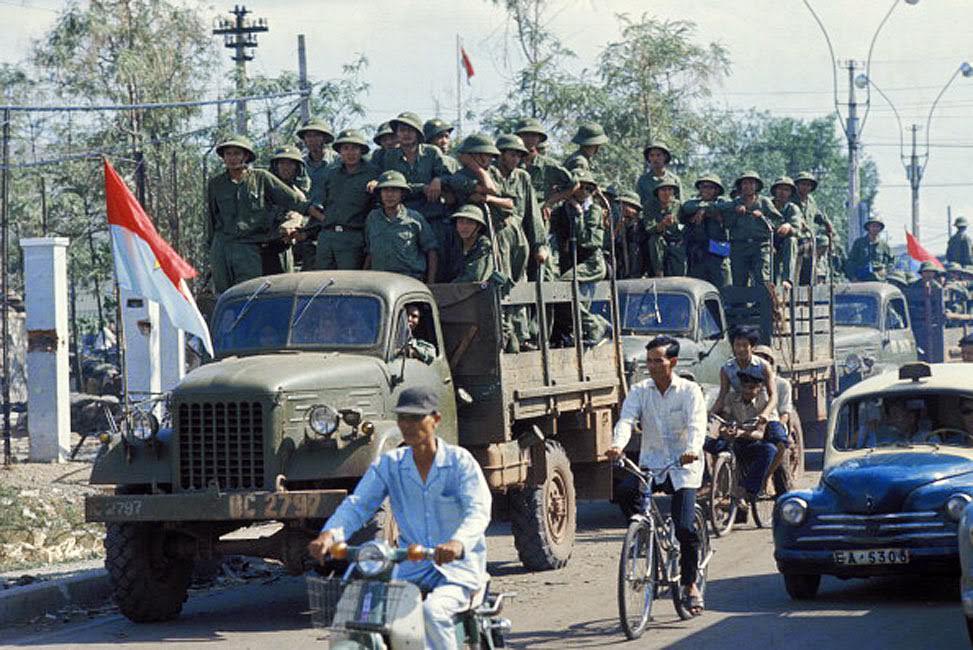
A line of military trucks rolls into Saigon, their beds crowded with uniformed soldiers in pith helmets as red flags ripple above the convoy. The road remains stubbornly ordinary around them—cyclists pedal past, a scooter slips through the foreground, and a compact car keeps pace—creating a jarring overlap of everyday city life and the arrival of a victorious force.
Details in the street scene anchor the moment in the Vietnam War without needing captions: utility poles and overhead wires, roadside greenery, and the dense, watchful posture of men riding high above the cab. The soldiers’ faces read as a mix of fatigue and focus, while the open trucks emphasize movement and momentum, the kind that turns political decisions into visible reality on a public avenue.
For historians and readers searching for “Vietcongs arriving in Saigon,” the photograph serves as a stark record of transition—one side entering the capital, the other era ending in the background. It also preserves the texture of the city itself: traffic continuing, civilians navigating around military vehicles, and a sense that history can arrive not only with gunfire but with engines, flags, and crowds passing in close proximity.