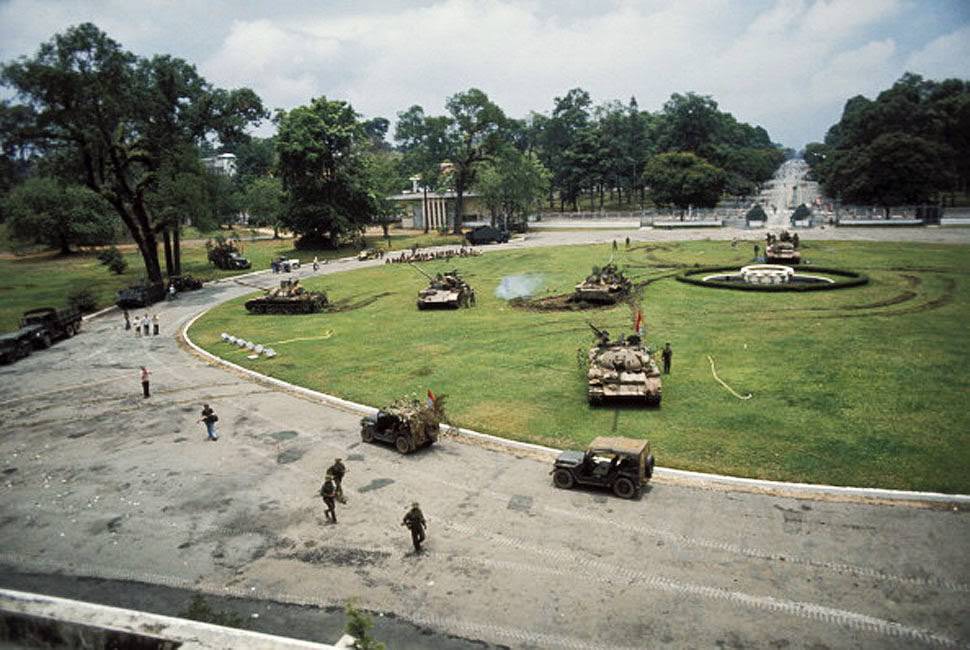
Armored vehicles roll across a broad, manicured lawn as soldiers spread out along the curved roadway, their movement breaking the calm geometry of a government compound. In the foreground, a tank advances past parked jeeps and scattered troops, while the open grounds ahead suggest a direct push toward a seat of power. The scene is framed by tall trees and formal landscaping, underscoring the contrast between civic order and sudden violence.
At the center of the grounds, a circular fountain sits like a marker in an improvised battlefield, with more armored units positioned beyond it and faint smoke lingering near one vehicle. The long boulevard in the background stretches toward a guarded entrance, hinting at the strategic importance of controlling approaches to the presidential palace. Even without close-up faces, the spacing of the troops and the coordinated placement of armor convey urgency, discipline, and the high stakes of an assault in an urban capital.
During the Vietnam War, attacks on symbols of government carried weight far beyond their immediate tactical outcome, shaping morale, propaganda, and international perception. This historical photo speaks to that larger story: the collision of military force with political authority, played out on grounds designed for ceremony rather than combat. For readers exploring Vietnam War history, presidential palace attacks, and the imagery of power under siege, it offers a stark, unforgettable window into a turning-point atmosphere.