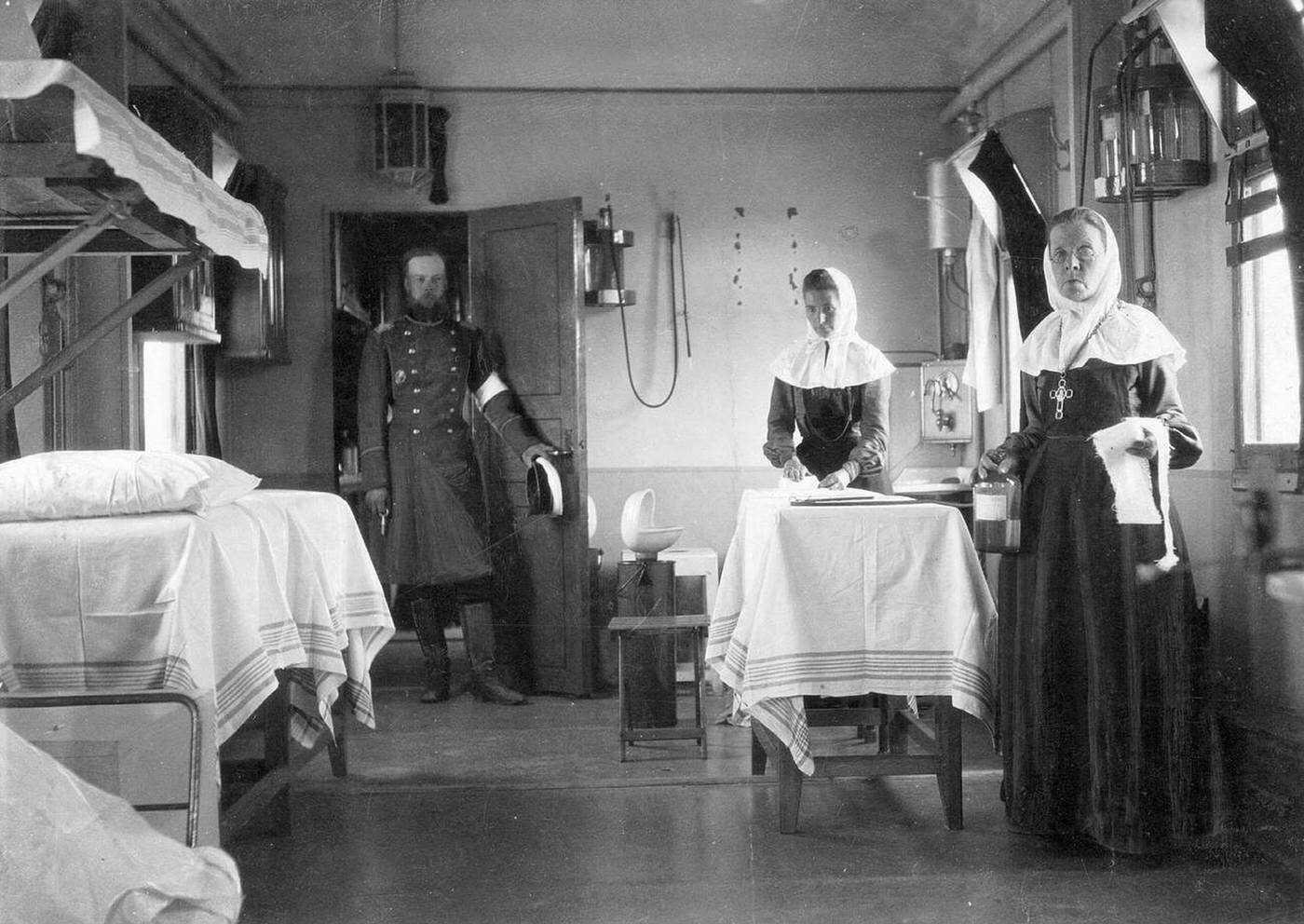
Inside a railcar arranged as a compact ward, the Russian Red Cross hospital train appears ready for the next wave of casualties in 1905. Neatly made beds line the cramped interior while a small table set for treatment anchors the center of the space, suggesting a routine of cleaning, preparation, and rapid response. A uniformed orderly stands near the doorway as two women in head coverings—likely nursing staff—hold their positions, turning a working medical compartment into a disciplined, almost domestic scene of wartime care.
Details in the carriage speak to early twentieth-century field medicine on the move: a basin for washing, hanging fixtures and containers, and spare instruments kept within reach. Light filters through the window, catching the stark whites of linens and bandages and emphasizing the cleanliness the Red Cross tried to maintain amid the grime of rail travel and the uncertainty of the front. The photograph’s careful composition also hints at the logistical backbone behind military campaigns, where trains served not only to deliver troops and supplies but to evacuate the wounded over long distances.
During the Russo-Japanese War, hospital trains like this became crucial links between battlefield triage and more permanent hospitals, embodying the era’s blend of industrial speed and humanitarian intent. The calm, posed figures contrast with the violence implied by the setting, reminding viewers that wars are also fought in quiet rooms where pain is managed and lives are stabilized. For readers interested in Russo-Japanese War history, Red Cross nursing, and military medical transport, this image offers a rare window into the practical realities of caring for soldiers in transit.