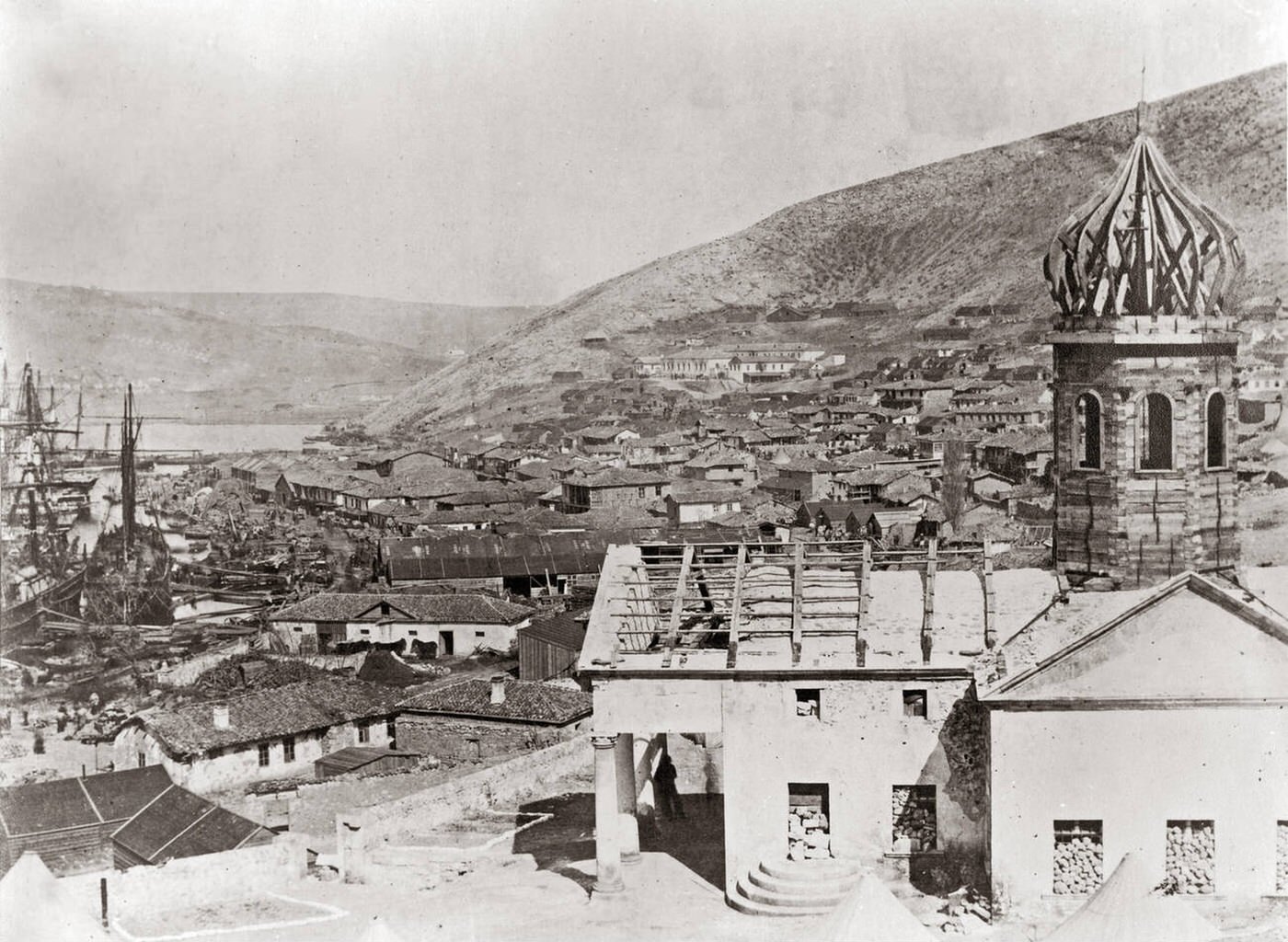
Rising above a dense patchwork of rooftops, the Russian church tower anchors the view across Balaclava in the 1850s, its skeletal dome structure standing out against the bare hills. Below it, tightly packed buildings spill down toward a sheltered harbor where masts and rigging crowd the waterfront, hinting at the constant traffic of ships and supplies. The scene balances everyday town life—homes, lanes, and workshops—with the unmistakable presence of wartime logistics.
Balaclava’s natural inlet made it a strategic prize during the Crimean War, and photographs like this one help explain why commanders fixated on the port. The shoreline appears busy and constricted, suggesting how quickly a modest settlement could be transformed into a military node feeding distant front lines. Even without showing a battlefield, the image conveys the pressures of conflict through congestion, construction, and the hard geometry of a town reshaped by necessity.
Along the right edge, the church structure becomes more than a landmark; it reads as a symbol of endurance amid upheaval, watching over the harbor and the climb of houses up the slope. Details such as unfinished or exposed roof framing and stacked materials in window openings add a quiet, documentary feel, inviting closer reading of how war alters streetscapes. For readers searching Crimean War history, Balaclava harbor, or Russian church architecture in wartime photography, this view offers a vivid, grounded window into the era.