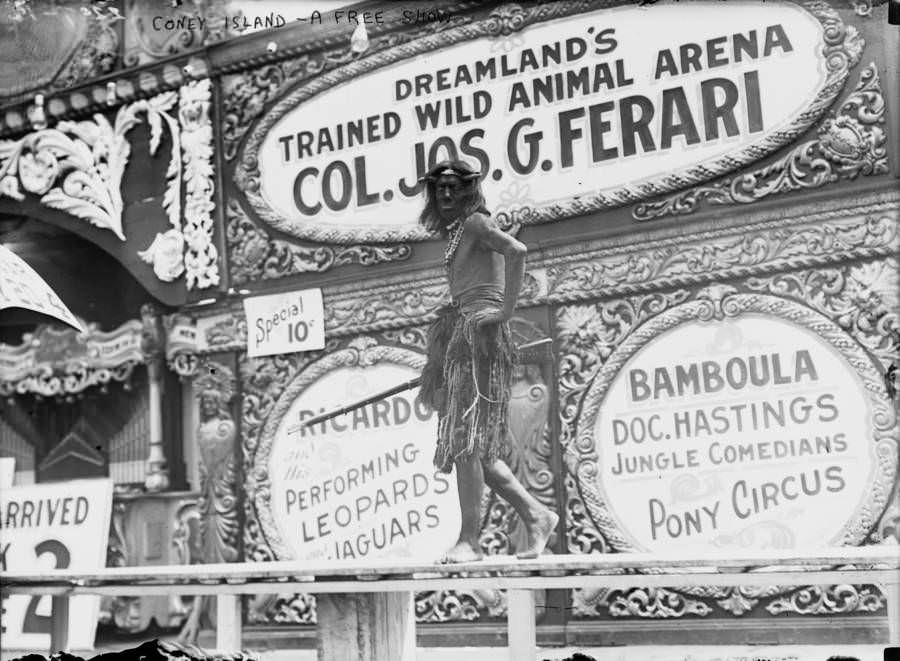
Under the lavish signage of Coney Island’s Dreamland Trained Wild Animal Arena, a sideshow performer stands elevated like a living billboard, turning the midway into a stage before the show even begins. The ornate façade is packed with bold lettering and scrollwork, advertising “a free show” and promising spectacle in the language of early amusement parks: loud, direct, and impossible to ignore. In the early 1910s, Dreamland’s branding leaned heavily on visual excess, and this moment distills that strategy into a single human figure posed against a wall of hype.
Reading the painted boards feels like scanning the entertainment menu of turn-of-the-century New York, where trained-animal acts and comedy routines competed for the same passing nickels and dimes. A “special 10¢” notice hints at how accessible these attractions were, and how carefully price and curiosity were balanced to keep the crowd flowing. Even without the roar of the arena, the photograph suggests the sensory overload of the boardwalk—barkers, music, and the constant shuffle of visitors drawn toward the next promise of danger or laughter.
Beyond its novelty, the image offers a window into the promotional machinery that made Coney Island a symbol of mass leisure in the early twentieth century. Sideshow performance here isn’t only an act; it’s marketing embodied, using costume, posture, and display to steer attention in a landscape built for impulse. For anyone interested in Coney Island history, Dreamland amusement park culture, or the evolution of American popular entertainment, this photograph captures how the spectacle started outside the arena—and how the crowd was gathered long before the curtain rose.