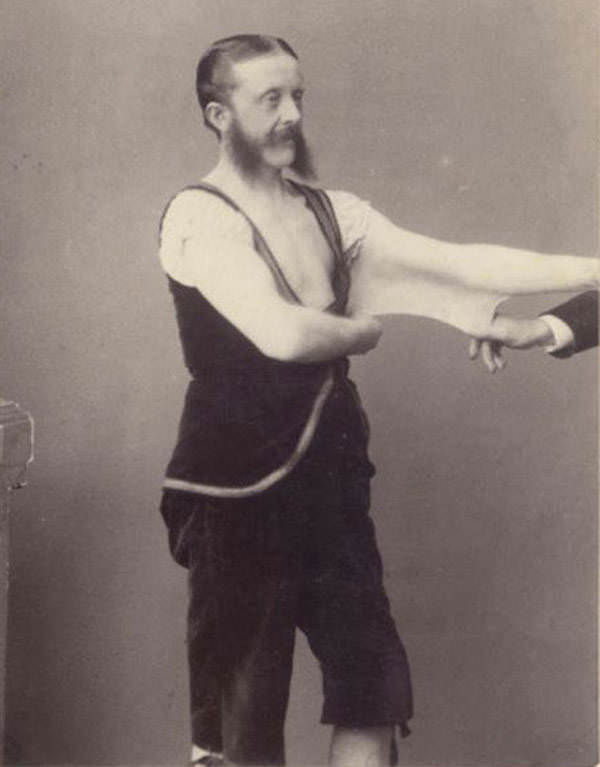
A bearded man stands in a simple studio setting, sleeves rolled and vest hanging loose, while his arm is extended toward an unseen person at the edge of the frame. The camera’s focus is unmistakable: skin pulled to an astonishing length, transformed into a living demonstration rather than a casual portrait. With little background detail to distract the eye, the photograph invites viewers to study the body itself and the uneasy fascination it stirred.
According to the title, this performer was Felix Wehrle, whose Ehlers-Danlos Syndrome made extraordinary skin elasticity possible and earned him the stage name “Elastic Man.” Images like this sit at the crossroads of medical curiosity and popular entertainment, echoing a time when unusual bodies were documented, exhibited, and marketed as proof of nature’s extremes. Even without captions or a visible venue, the careful pose and the assisting hand suggest a rehearsed act—part science lesson, part spectacle.
Seen today, the photograph reads differently than it likely did when first circulated, prompting questions about disability, agency, and the cost of being turned into a public marvel. For readers searching the history of Ehlers-Danlos Syndrome, sideshow culture, or early medical photography, it offers a stark reminder of how rare conditions were framed for mass consumption. The “Elastic Man” label may have drawn crowds, but the image also preserves a human presence behind the act—steady gaze, composed posture, and a life reduced to a single astonishing trait.