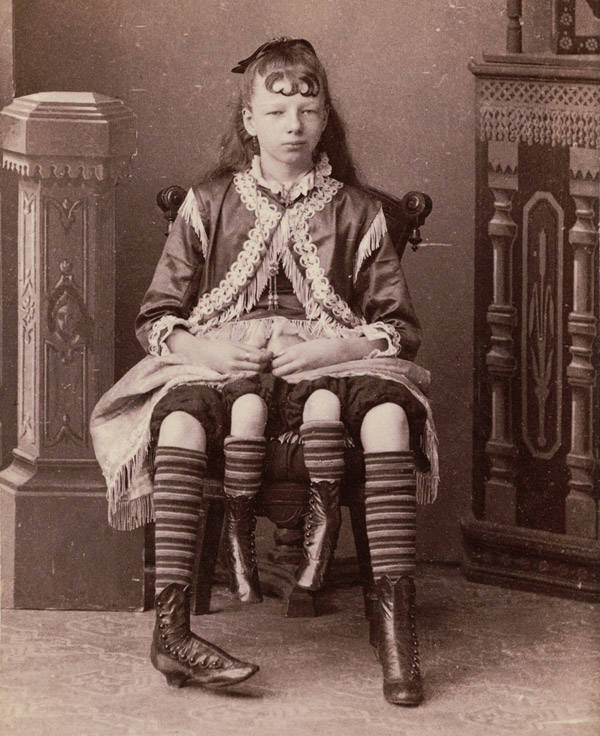
Seated squarely in a studio chair, Myrtle Corbin faces the camera with a calm, almost practiced composure, dressed in a neatly trimmed outfit with decorative braid and fringe. The photographer’s setting—ornate furniture, patterned backdrop, and careful lighting—frames her as a formal portrait subject rather than a novelty, even as the composition draws the eye downward. Long striped stockings and high-button boots emphasize the symmetry of her pose and the unusual anatomy that made her widely discussed in the 19th century.
Dubbed the “Four-Legged Girl From Texas,” Corbin was born with a severe congenital deformity that left her with two separate pelvises and a smaller set of legs. In the image, the additional limbs are positioned between her outer legs, smaller in scale and partly tucked forward, a visual detail that explains why audiences of the era fixated on her body. Photographs like this operated as both documentation and advertisement, circulating through dime museums and sideshow culture where disability was routinely packaged as entertainment.
Looking at the portrait today invites a different kind of attention: not only to the medical rarity, but to the person behind the label. Her steady gaze, tidy hair ribbon, and carefully arranged hands suggest agency within a world eager to define her by spectacle. For readers searching the history of Myrtle Corbin, congenital deformities, and American sideshow photography, this 1882-era portrait offers a stark window into how bodily difference was recorded, marketed, and remembered.