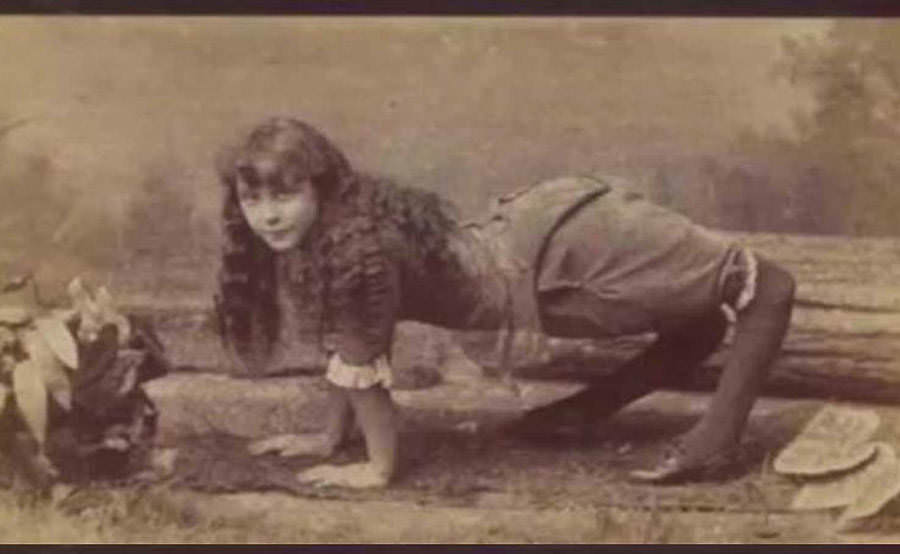
A young performer poses low to the ground on hands and feet, her legs angled in a way that makes the joints look startlingly reversed, while she meets the camera with a calm, practiced gaze. The studio-style backdrop and staged props lend the scene an air of theater, as if the photograph itself is part advertisement, part souvenir. Even in this single frame, the tension between spectacle and personhood is hard to miss.
According to the title, Ella Harper—billed as the “Camel Girl”—was born with a very rare orthopedic condition that caused her knees to bend backward, a difference that touring freak show promoters turned into a marketable act. That phrasing, common in the era of sideshows and “curiosity” exhibits, reminds us how disability was routinely packaged for mass entertainment. Her reported $200-per-week salary hints at the commercial scale of the circuit, and at the complicated mix of opportunity, exploitation, and public fascination that surrounded such performers.
Looking closely, the details of dress and posture suggest both control and constraint: she is positioned to emphasize anatomy, yet her expression reads composed rather than defeated. For readers searching historical photos of Ella Harper, the Camel Girl, or the broader history of freak shows and disability representation, this image offers a sobering window into how bodies were photographed, sold, and remembered. It invites a more careful viewing—one that acknowledges the industry’s harshness while still granting the subject the dignity of being seen as more than a headline.