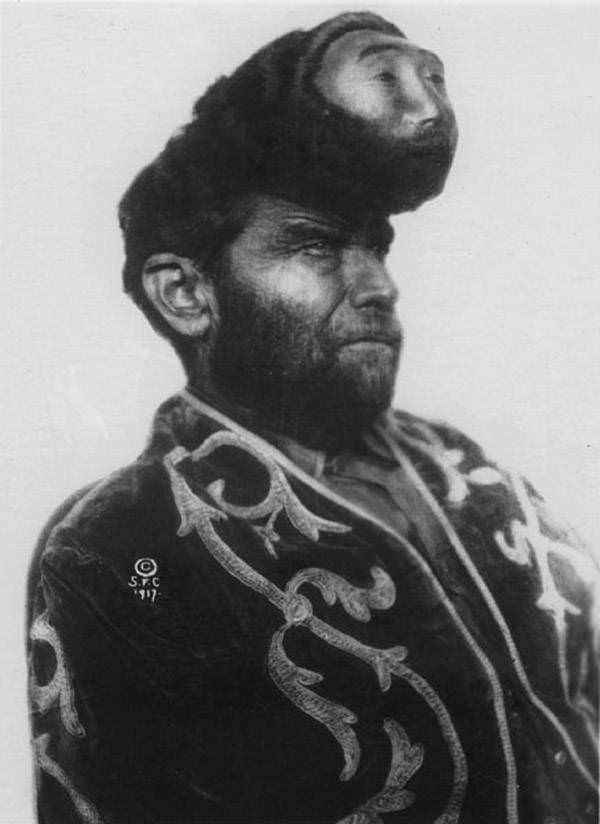
Pasqual Pinon appears in profile, dressed for the stage in an embroidered jacket, his gaze set forward with a steady, unsmiling calm. Perched above his forehead is the “second head” that made him famous on the American touring circuit—a carefully crafted wax face fitted over a tumor, complete with dark hair and a stylized expression. The stark studio backdrop keeps attention on the startling silhouette and the deliberate performance of identity that surrounds it.
In 1917, sideshow and carnival promoters sold audiences a mix of spectacle, medical curiosity, and exoticized advertising, and Pinon was billed as the “Two-Headed Mexican” as he traveled across the United States. The detail that the growth was decorated rather than merely displayed hints at both ingenuity and pressure: a personal condition turned into a marketable persona, shaped by costuming, photography, and the public’s appetite for the unusual. Even without a bustling midway in view, the image carries the atmosphere of early 20th-century popular entertainment, where a single portrait could function as poster, proof, and lure.
Seen today, the photograph invites a more careful reading than a quick label like “weird.” It’s a window into how disability, show business, and ethnic stereotyping were packaged together in the era’s promotional culture, and how performers navigated that world to make a living. For readers searching historical oddities, circus sideshow history, or the story behind the “Two-Headed Mexican,” this portrait offers an unforgettable starting point—and a reminder that spectacle always has a human cost.