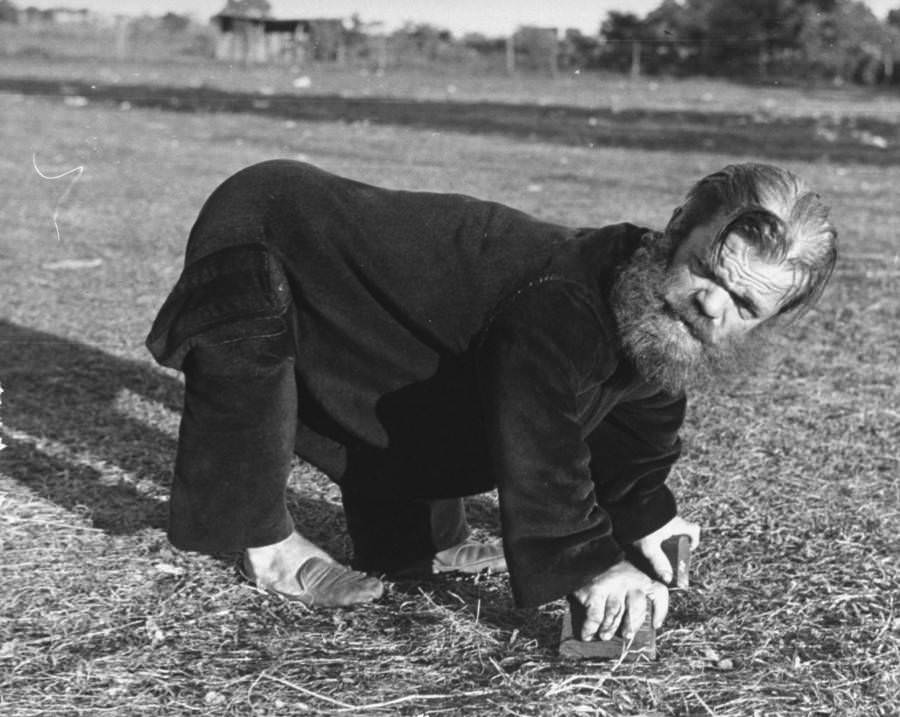
Under an open fairground sky, the performer billed as “Bear Man” crouches low to the grass, moving on all fours with an intensity that feels half-playful, half-defiant. His thick beard and carefully styled hair frame a face turned toward the camera, as if acknowledging the crowd’s stare while refusing to be reduced to it. The simple dark outfit and the wide, empty field behind him keep the focus on posture and presence—an act built on physicality as much as spectacle.
Greenbrier Valley Fair in 1938 would have offered the familiar comforts of rural entertainment—livestock, contests, food stands—alongside the kinds of sideshow attractions that drew extra nickels during the hard years. “Bear Man,” described in the title as a bearded dwarf, sits squarely in that tradition of curiosity acts, where difference was packaged as wonder for paying audiences. Seen today, the photograph carries a double charge: it documents a real working performer and also hints at the uneasy line between applause and exploitation in American fair culture.
Details in the background are soft and distant, yet that blur is part of the story, emphasizing how fleeting such moments were in the churn of a traveling season. The image works as a vivid piece of 1930s Americana—an outdoor performance captured mid-pose, equal parts carnival theater and human portrait. For readers searching for Greenbrier Valley Fair history, 1938 fair photos, or the era’s sideshow performers, this frame offers a memorable, unsettling glimpse into the entertainment world of the time.