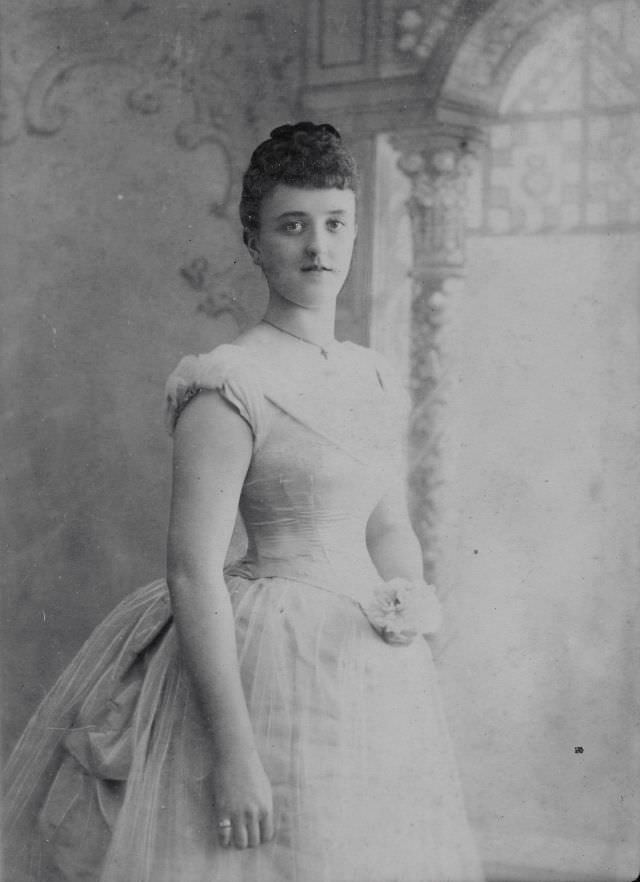
Poised before a painted studio backdrop and a bright arched window, a young woman stands in three-quarter view, meeting the camera with a calm, practiced gaze. Her hair is swept up in the late 19th-century style, and the softly lit portrait emphasizes the smooth line of her bodice and the narrow waist that Victorian fashion prized. A delicate necklace and a small floral accent at the wrist lend a note of refinement without distracting from the silhouette.
The tight corset—largely hidden beneath the dress yet unmistakable in its shaping—creates the structured torso that defined fashionable womenswear of the era. Above the cinched middle, the neckline sits modestly, while the skirt falls in pale, layered fabric that suggests light tulle or gauze, gathered to fuller volume at the back. The resulting hourglass outline was not merely aesthetic; it acted as the foundation for formal gowns, guiding how fabric draped, where seams lay, and how the wearer held herself.
Studio portraiture like this helped turn Victorian ideals of femininity, etiquette, and social status into widely shared visual culture. The controlled setting, gentle lighting, and careful posture highlight how clothing functioned as both private undergarment technology and public statement, making the corset an “indispensable” tool of late-19th-century fashion. For modern viewers searching Victorian corsets, women’s fashion history, or late 1800s style, the image offers a quietly intimate glimpse of how structure and softness were balanced in everyday elegance.