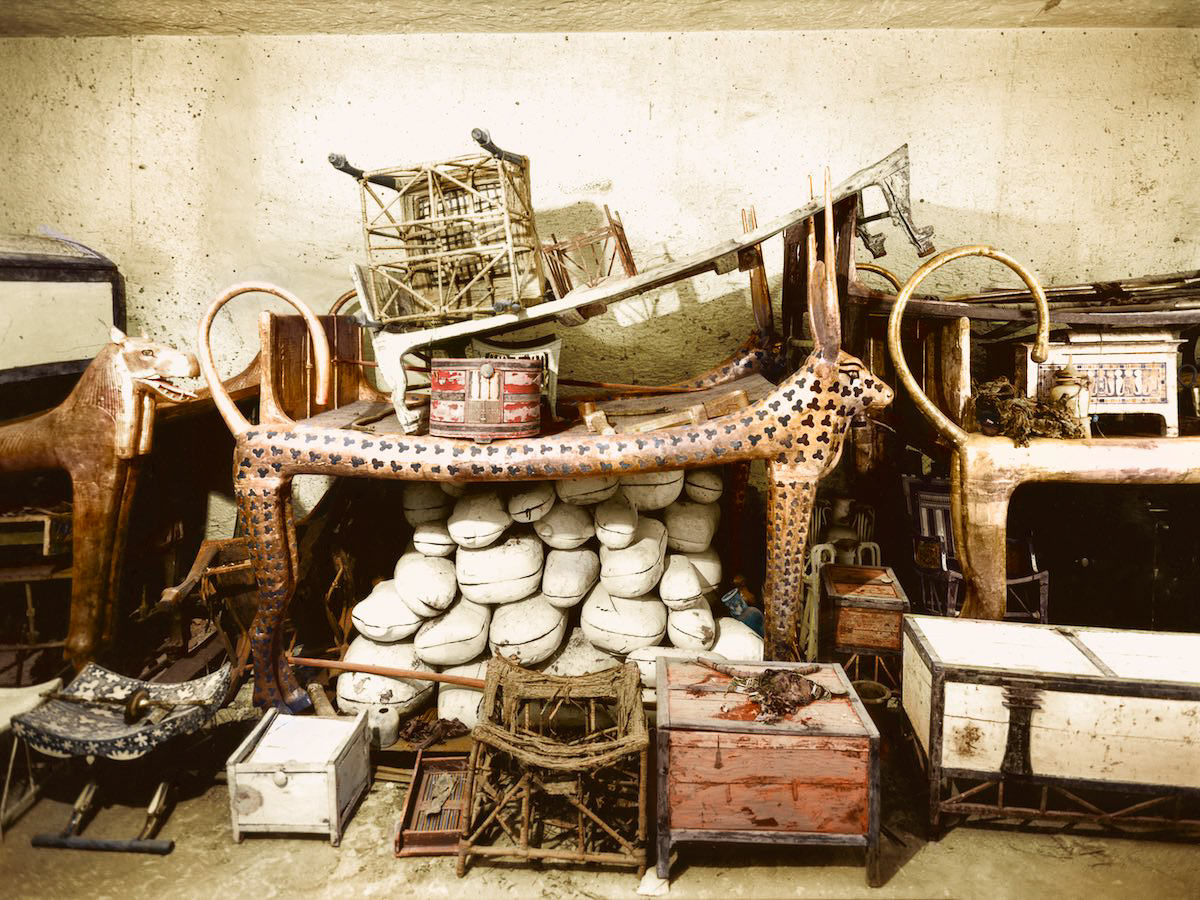
Along the west wall of the Antechamber, the burial goods from Tutankhamun’s Tomb appear less like a tidy “treasure” and more like a lived-in storeroom, stacked in urgent layers. The cow-headed couch (Carter no. 73) dominates the scene with its curved rails and animal-headed terminals, its painted surface still holding onto pattern and sheen even amid the crush of surrounding objects. In this colorized view, the pale wall and dusty floor throw the warm tones of wood and gilding into relief, giving modern eyes a clearer sense of texture, scale, and the sheer press of items in that cramped space.
Beneath and around the couch, boxes containing joints of meat (Carter nos. 62a to 62vv) are piled like provisions for a journey that was meant to last forever. Their rounded, bundled forms and careful containment speak to ritual practicality: offerings preserved, labeled, and stored among furniture and ceremonial equipment rather than separated as “food” in any ordinary sense. The jumble of chests, frames, and nested pieces—some upright, some tipped, some partly obscured—shows how the Antechamber functioned as a packed threshold between rooms, where objects were arranged for burial needs, not for display.
December 1925 places this photograph in the painstaking phase of documentation and clearance, when every artifact had to be recorded, numbered, and stabilized before removal. That methodical work is echoed in the title’s Carter catalogue references, reminders that what looks chaotic was being translated into an ordered archaeological record. For readers searching for Tutankhamun tomb photos, Antechamber artifacts, or the famous animal-headed couch, this image offers a rare, immediate view of how the assemblage once sat in situ—crowded, fragile, and astonishingly intact.