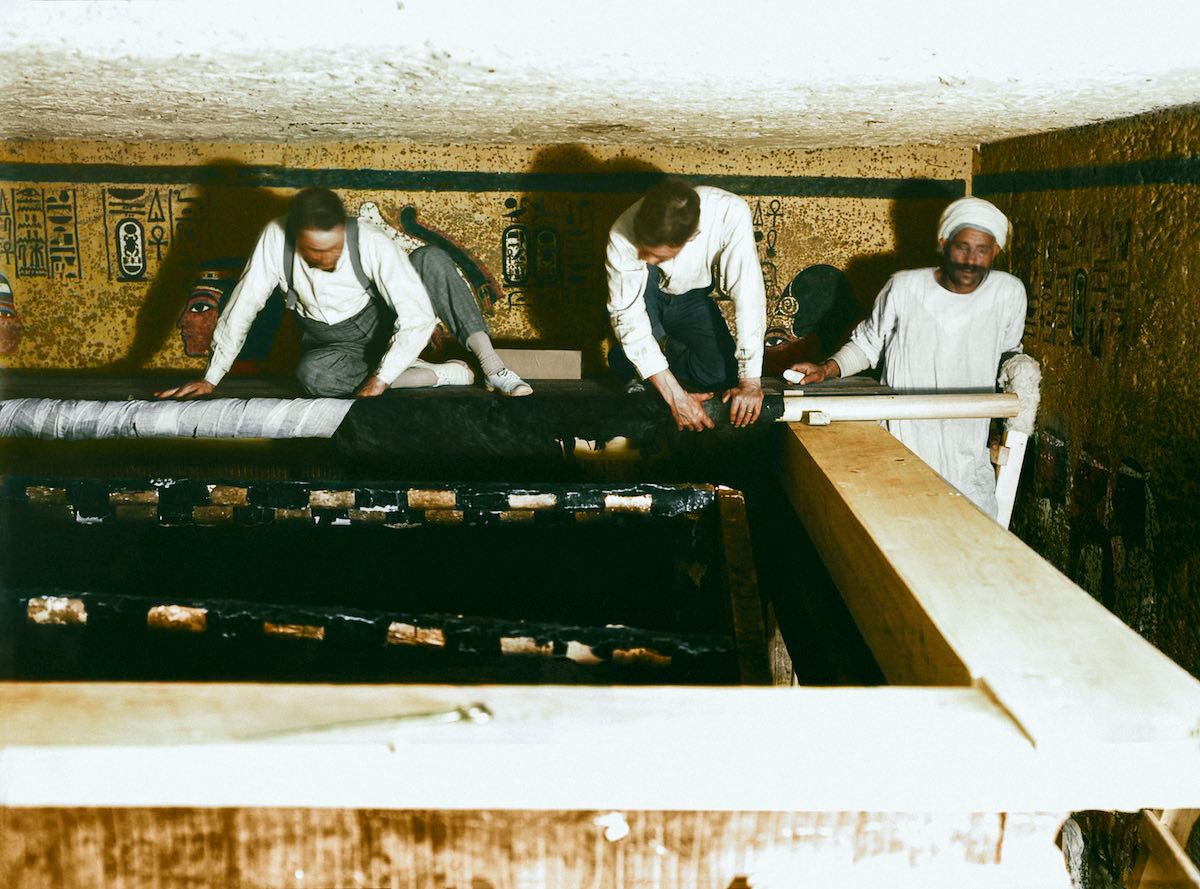
Pressed close to the painted walls of Tutankhamun’s tomb, Howard Carter and Arthur Mace work from a narrow run of scaffolding while an Egyptian workman stands nearby, steady and watchful. The title’s moment—rolling back a linen pall—turns the scene into a study of careful hands and controlled breath, where every movement mattered. Colorization lends immediacy to the cramped chamber: the warm tones of the masonry, the dense shadows under the low ceiling, and the pale fabric drawn back over dark surfaces.
Between the wooden supports and the tight clearance above, the space feels engineered as much as excavated, a temporary architecture built to protect what lay beneath. Behind the men, bands of hieroglyphs and funerary imagery run across the wall, reminding the viewer that this was never meant for modern eyes or electric light. The contrast between fresh timber and ancient decoration underscores the uneasy meeting of early 20th-century archaeology and a royal burial sealed for millennia.
Dated 30th December 1923 and identified as Carter no. 209, the photograph records not a triumphal unveiling but the slow, methodical labor of conservation inside one of Egypt’s most famous discoveries. It also preserves a collaborative reality often flattened in popular retellings: specialists and local workers sharing risk, skill, and patience in a confined room. For readers searching for Howard Carter, Arthur Mace, Tutankhamun’s Tomb, or the opening of the burial chambers, this image offers an intimate, human-scale view of the work behind the legend.